

What Is a European Power Cord?
A European power cord is a cord set built to EN 60799, the standard for a non-rewirable plug, a flexible cable and a non-rewirable connector or appliance inlet supplied as one assembly. The plug is normally from the CEE 7 family, the round-pin system that took over from the separate national plugs of Germany, France, Belgium and the Scandinavian countries. The same cable platform carries a 2-pole Europlug on a table lamp and a 3-pole Schuko plug on a server, so the market is usually served by one cord design in several versions.
Mains voltage through the European Union is 230 V at 50 Hz, the value agreed in IEC 60038 when the old 220 V and 240 V national supplies were drawn together, which is why European equipment nameplates read 220-240 V. Three-phase supplies are 400 V. A single-phase cord therefore carries up to 16 A, a little under 3.7 kW, and what decides the cord is the socket in the destination market, the current the appliance draws, and the approval marks the buyer expects to see on the certificate.
European approval practice differs from North America. There is no single mandatory listing such as UL for cord sets: the manufacturer declares CE conformity against the low voltage rules, and the third-party marks on a cord certificate are issued by national bodies, most of them working inside the ENEC scheme. That is why the same cord set design is often certified for several countries at the same time, with VDE for Germany, DEMKO for Denmark, NEMKO for Norway, SEMKO for Sweden, FIMKO for Finland, CEBEC for Belgium, OVE for Austria, KEMA for the Netherlands and SEV for Switzerland.
European Power Cord Quick Facts
- Plugs: CEE 7/16 Europlug at 2.5 A, CEE 7/17 unearthed at 16 A and CEE 7/7 Schuko at 16 A, plus the Danish Type K, the Swiss Type J and the five-pin Perilex plug for three-phase cooking appliances
- Mains: 230 V, 50 Hz single phase, 400 V three phase; up to 16 A on a single-phase cord, about 3.7 kW
- Cord set standard: EN 60799; plugs to EN 60884-1 and DIN VDE 0620-1; Europlug to EN 50075; connector ends to EN 60320-1
- Cable: harmonised H03VVH2-F and H05VVH2-F (flat 2-core), H05VV-F PVC, H05RR-F, H05RN-F and H07RN-F rubber, H05Z1Z1-F halogen-free, in 0.5 mm² to 1.5 mm² as standard
- Connector ends: IEC 60320 C5, C7, C13, C14, C15, C19 and C20 in straight, left-angle and right-angle versions, or stripped and tinned for terminal blocks
- Approvals: ENEC, VDE, TUV, DEMKO, NEMKO, SEMKO, FIMKO, CEBEC, OVE, KEMA and SEV marks, with RoHS, REACH and PAHs compliance as standard
What Decides the Cord You Need
- The socket in the target country. Germany, France and the Netherlands all take a CEE 7/7 plug, while Denmark and Switzerland need plugs of their own
- The current the appliance draws, which sets the conductor size, from 0.5 mm² on a 2.5 A Europlug lead up to 1.5 mm² on a full 16 A cord
- The connector at the appliance end: C5 or C7 for small power supplies, C13 and C15 for IT equipment and heating appliances, C19 and C20 above 10 A
- The marks the buyer names, which decide which certification body tests the design, and whether the order needs an ENEC certificate on its own or a national mark beside it
- Where the cord is used, because a rubber H05RN-F or H07RN-F lead survives cold, damp and rough handling that a PVC lead does not
CEE 7 Plug Types and National Plugs
The CEE 7 standard sheets define the plugs; the sockets they fit are national standards that were harmonised around them. In practice five plugs cover almost every European order, and the choice is settled by the socket, by whether the appliance is Class I or Class II, and by the current it draws.
| Plug | Standard | Rating | Earth contact | Where it fits |
|---|---|---|---|---|
| CEE 7/16 Europlug (Type C) | EN 50075, from CEE 7 Standard Sheet XVI Alternative II | 2.5 A, 250 V | None | Every round-pin European socket: CEE 7/3 Schuko, French Type E, Danish, Swiss, Italian 10 A and IEC 60906 type N sockets |
| CEE 7/17 | CEE 7 Standard Sheet XVII | 16 A, 250 V | None | Schuko and French sockets, for Class II equipment drawing more than the 2.5 A of a Europlug |
| CEE 7/7 Schuko (Type E/F) | CEE 7 Standard Sheet VII, DIN VDE 0620-1 | 16 A, 250 V | Two side clips for Schuko sockets, plus a face opening that takes the French earth pin | Germany, France, the Netherlands, Spain, Austria, Belgium, Poland, the Nordic countries, Turkey and most other continental markets |
| Danish Type K | AFSNIT 107-2-D1 (DS 60884-2-D1) | 13 A loaded at 250 V, standard rated 16 A | Half-moon earth pin below the two current pins | Denmark, Greenland and the Faroe Islands |
| Swiss Type J | SN 441011, formerly SEV 1011 | 10 A (type 13) and 16 A (type 23) versions | Offset round earth pin | Switzerland and Liechtenstein |
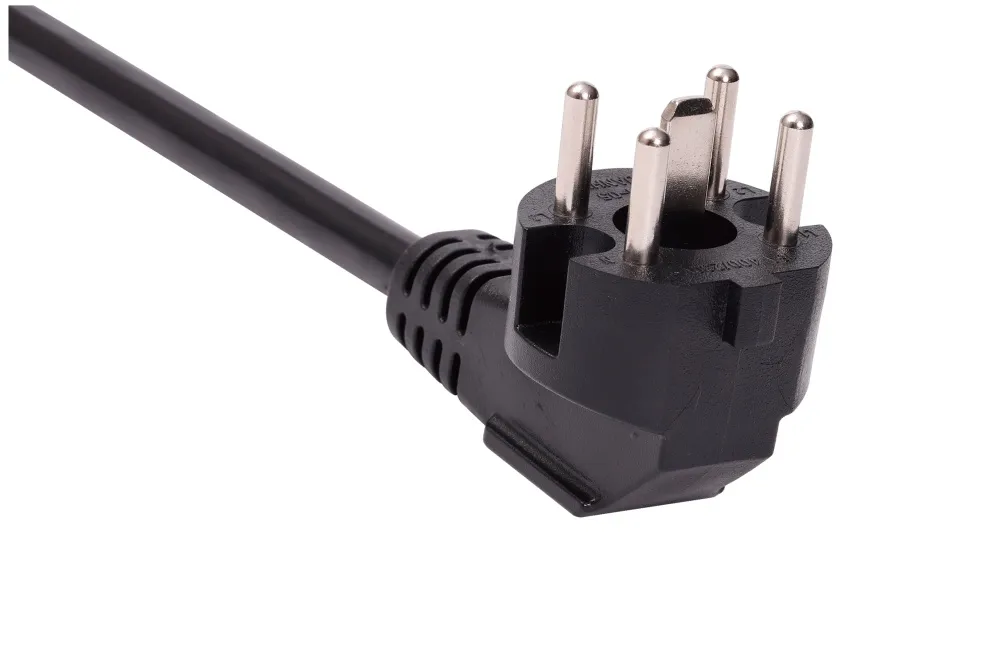
| Perilex | DIN 49445 socket and DIN 49446 plug for 16 A; DIN 49447 and DIN 49448 for 25 A | 16 A, 230/400 V three phase | Earth pin at the centre of the five-pin pattern | Germany, the Netherlands and Sweden, on cookers, stoves and other three-phase appliances |


How the Plug Types Relate
- The CEE 7/7 plug is the European universal. It carries both earth systems at once, side clips for the German Schuko socket and a face opening that fits over the earth pin of a French socket, so one plug serves Germany, France, Belgium, the Netherlands, Spain, Poland and the Nordic countries
- The Europlug is the universal unearthed plug. Its 4 mm pins on 19 mm centres enter every round-pin European socket, but it carries no earth and is limited to 2.5 A, so it belongs on Class II equipment only and cannot be rewired: EN 50075 requires it to be molded onto the cable
- CEE 7/17 fills the gap between them. It is unearthed like a Europlug but rated 16 A, which suits Class II appliances such as large power supplies and audio equipment in markets that accept an unearthed plug
- Denmark and Switzerland keep their own earthed plugs. A Schuko plug enters a Danish socket but leaves the earth unconnected, and Swiss sockets need the SN 441011 plug for an earthed appliance. Order the Danish Type K and the Swiss Type J instead of relying on a Schuko
- Perilex carries three phases. The five-pin pattern feeds a cooker or stove at 400 V, and it is the plug used where a single-phase 16 A cord is simply not enough power
Cords for these markets are built to order, so plug, cable, length and colour are specified together rather than picked from a list. The power cord customization guide → sets out the six steps and the order checklist, and the wire end options guide → covers the appliance end when it is not an IEC connector.
Approvals and Certification Marks
Two separate requirements decide what a European cord carries. The first is legal: CE marking for the low voltage directive (2014/35/EU) or the applicable harmonised standard, declared by the manufacturer and held together by the technical file. The second is commercial: the third-party marks a distributor, retail chain or OEM customer asks to see on the test certificate.
Continental Europe has more national marks than any other region, because each country had an approval institute of its own before CENELEC harmonised the standards. Most of those institutes now work inside the ENEC scheme, which certifies a product once against the European standard and issues the ENEC mark beside the national one. Cord sets are covered under ENEC 303, applied to EN 60799, and appliance couplers under EN 60320. One cord set design can therefore hold VDE, DEMKO, NEMKO, SEMKO, FIMKO, CEBEC, OVE, KEMA and SEV approvals at the same time, tested to the same EN standards.
 VDE (Germany)
 TUV (Germany)
 ENEC (Europe)
 DEMKO D mark (Denmark)
 NEMKO (Norway)
 SEMKO (Sweden)
 FIMKO (Finland)
 CEBEC (Belgium)
 OVE (Austria)
 KEMA (Netherlands)
 SEV (Switzerland)
 CE
CE
 RoHS
RoHS
 REACH
REACH
 PAHs
PAHs
| Mark | Country | Issued By | What It Covers on a Cord |
|---|---|---|---|
| ENEC | Europe | The ENEC scheme, run by CENELEC certification bodies including VDE, Nemko, SGS FIMKO, SGS CEBEC, Intertek Semko, OVE, DEKRA, IMQ, TUV and UL | Third-party certification to the European standards. Cord sets sit under ENEC 303, applied to EN 60799, and appliance couplers under EN 60320, so an ENEC certificate already covers the plug, the cable and the connector as one assembly. |
| VDE | Germany | VDE Institute, Offenbach | Plugs, socket-outlets and couplers to DIN VDE 0620 and the EN 60320 series, with production surveillance. The mark named most often in German purchasing specifications and in the largest share of European tenders. |
| TUV | Germany | TUV Rheinland and TUV SUD | Component and product certification for the German market, including the GS mark where a licensed product safety mark is wanted on top of the cord approval. |
| DEMKO (D mark) | Denmark | UL International Demko A/S, Ballerup | Danish approval of cord sets, plugs and couplers, issued with a CB test certificate that other certification bodies accept for their own national marks. |
| NEMKO (N mark) | Norway | Nemko | Norwegian certification of plugs, couplers and cord sets, still requested in Norwegian and wider Nordic tenders. |
| SEMKO (S mark) | Sweden | Intertek Semko | The Swedish approval mark, historically required before an electrical product could be sold in Sweden and still used as the national mark in Nordic certificates. |
| FIMKO (FI mark) | Finland | SGS FIMKO | Finnish certification for plugs, couplers and cord sets, issued alongside the ENEC mark for the Finnish market. |
| CEBEC | Belgium | SGS CEBEC | Belgian certification mark used on cords, plugs and installation material, and recognised by Belgian wholesalers and utilities. |
| OVE | Austria | OVE, the Austrian electrotechnical association | Austrian certification mark for plugs, couplers and cord sets, issued under the ENEC scheme with Austrian national recognition. |
| KEMA | Netherlands | KEMA, now operated within DEKRA | Dutch certification mark, historically required for products sold in the Netherlands and still named in Dutch specifications. |
| SEV | Switzerland | Electrosuisse (SEV) | Swiss certification. The Swiss plug system itself is SN 441011, known as SEV 1011 in older documents, in 10 A and 16 A versions. |
| CE | EU and EEA | Manufacturer declaration | The legal route to the European market for the finished product. It is declared and supported by the technical file rather than issued by a certification body, which is why buyers ask for the ENEC or national certificate as well. |
Standards Behind a European Cord Set
| Standard | What It Covers | Why It Matters |
|---|---|---|
| EN 60799 | Cord sets and interconnection cord sets: a non-rewirable plug, a flexible cable, and a non-rewirable connector or appliance inlet supplied as one assembly. | The standard the finished lead is certified against. The plug and connector standards apply to the parts, EN 60799 to the cord set as a whole, which is why the certificate names all three. |
| EN 60320-1 | Appliance couplers for household and similar use, rated up to 250 V and 16 A, with the standard sheets in EN 60320-3. | Defines the C5, C7, C13, C15 and C19 connector ends and the C14 and C20 inlets, including their temperature ratings. A "10 A, 120 °C" marking on a cable comes from here. |
| EN 60884-1 / DIN VDE 0620-1 | Plugs and socket-outlets for household and similar purposes. | The plug side of the assembly, applied nationally in Germany as DIN VDE 0620-1. It sets pin dimensions, cord grip, temperature rise and the type tests a CEE 7/7 plug has to pass. |
| EN 50075 | Flat non-rewirable two-pole plug, 2.5 A 250 V, with cord, for the connection of Class II equipment. | The Europlug standard. It defines a plug only, so a Europlug has to be molded onto the cable: a rewirable plug of the same shape is not EN 50075 compliant. |
| EN 50525 / HD 22 and the HAR agreement | Harmonised flexible cables, with H03VVH2-F, H05VVH2-F, H05VV-F and H07RN-F among the types covered by the HAR certification procedure. | The cable has to be an approved harmonised type, otherwise the cord set approval does not extend to it. The HAR mark on the cable is the evidence a buyer can check. |
| RoHS, REACH, PAHs | Restricted substances in PVC compounds, plastics and parts handled by the user. | Standard in European tenders and retail specifications. Ask for a test report for the compound actually used on the order rather than a generic certificate. |
Specifications and Ratings
Four variables define a European cord: the plug, the harmonised cable type, the conductor size and the connector end. The cable has to suit both the current and the place the cord is used, and the connector end sets the maximum the assembly can deliver even when the plug itself is rated higher.
Harmonised Cable Types
| Cable | Cores and Size | Voltage Class | Typical Use |
|---|---|---|---|
| H03VVH2-F | 2 x 0.5 or 0.75 mm², flat | 300/300 V | Europlug leads on lamps, radios, chargers and other Class II equipment up to 2.5 A |
| H05VVH2-F | 2 x 0.75 or 1.0 mm², flat | 300/500 V | 2-pole cords where the flat profile is wanted and the current is above the H03 range |
| H03VV-F / H05VV-F | 2 or 3 core, 0.5 to 1.5 mm² | 300/300 V and 300/500 V | PVC cords for office equipment, appliances and lighting, and the default cable for Schuko leads |
| H05RR-F / H05RN-F | 2 or 3 core, 0.75 to 1.5 mm² | 300/500 V | Rubber cords that stay flexible when cold and survive wiping, light mechanical stress and outdoor use |
| H07RN-F | 3 core, 1.0 to 2.5 mm², with 2-core versions | 450/750 V | Heavy rubber for tools, workshops and site equipment, often moulded with an IP44 plug |
| H05Z1Z1-F / H05Z1Z1H2-F | 3 core and flat 2-core, 0.75 to 1.5 mm² | 300/500 V | Halogen-free LSZH cords for public buildings, tunnels and rail, where smoke and corrosive gas are the concern |
The code reads left to right: H for a harmonised cable, 03, 05 or 07 for the 300/300 V, 300/500 V and 450/750 V voltage classes, the insulation and sheath letters (V for PVC, R for rubber, N for polychloroprene, Z1 for halogen-free), H2 for a flat construction, and F for a flexible fine-strand conductor. So H05VV-F 3G1.5 is a PVC-insulated, PVC-sheathed cord with three cores including a green-yellow earth, 1.5 mm² each. Cords with an X in place of the G carry no earth conductor.
Current Carrying Capacity
| Cross-Section | Typical Current | Where It Is Used on a Cord |
|---|---|---|
| 0.5 mm² | 3 A | 2-pole Europlug leads on lamps, radios and small power supplies |
| 0.75 mm² | 6 A | 2-pole and 3-pole cords for monitors, laptops and appliances below 6 A |
| 1.0 mm² | 10 A | IT equipment, C13 and C15 leads, and domestic appliances up to 10 A |
| 1.5 mm² | 16 A | Full 16 A Schuko leads, C19 server and PDU cords, kitchen appliances |
| 2.5 mm² | 20 A on 3-core | Industrial leads and long runs where voltage drop matters more than flexibility |
Figures are the tabulated capacities for flexible cords with a 60 °C conductor temperature, as used in the EN 50525 cable standards and the HD 60364-5-52 installation tables. Ambient temperature and grouping reduce them, so a cord run inside a hot cabinet or bundled with others should be sized one step up rather than at the limit. A moulded plug marked 16 A on 0.75 mm² cable is mislabelled rather than generous.
IEC 60320 Connector Ends
| Connector | Rating | Typical Use |
|---|---|---|
| C5 / C6 | 2.5 A, 250 V | Three-pin clover-leaf connector on laptop power supplies, projectors and small chargers |
| C7 / C8 | 2.5 A, 250 V | Two-pin figure-of-eight connector on radios, set-top boxes, audio equipment and small power supplies |
| C13 / C14 | 10 A, 250 V | The standard coupler for power supplies, monitors, PDUs, instruments and appliances |
| C15 / C16 | 10 A, 250 V, 120 °C | High-temperature version of C13 with a locating keyway, for kettles, urns, heaters and appliance inlets that run hot |
| C19 / C20 | 16 A, 250 V | Servers, UPS units, PDUs and larger instruments, and the connector that matches a full 16 A Schuko lead |
Straight, left-angle and right-angle C13 bodies are moulded to order, and the angled versions are what keep a rack lead from pushing the connector out of a crowded PDU. The connector end also caps the assembly: a Schuko-to-C13 cord carries a 16 A plug but the C13 connector is rated 10 A, so a load above 10 A needs a C19 end. IEC 60309 industrial plugs and sockets take over above 16 A, or wherever a three-phase supply has to be connected.
Lengths, Colours and Jackets
- Lengths from 1.0 m to 5.0 m are standard export sizes, with longer leads built on a heavier conductor so the current still arrives at the appliance
- Colours: black and white as standard, with grey, red, blue and green for OEM orders that need to match a product or mark a function
- Jackets: PVC for indoor and office use, rubber for cold, damp and rough conditions, halogen-free compound for public buildings, and textile braid where the cord is part of the product design
- Marking and packing: customer logo or part number can be moulded into the plug body, with individual bags, bulk cartons or retail packs to the order
Which Countries Use Which Plug
The socket decides the plug, and the socket standard is national even where the plug is shared. The table below groups the markets by socket type and names the plug to order for each.
| Market | Socket | Plug to Order |
|---|---|---|
| Germany, Austria, Netherlands, Spain, Portugal, Greece, Sweden, Norway, Finland, Iceland, Hungary, Croatia, Serbia, Turkey | CEE 7/3 Schuko, Type F, with earth clips in the socket recess | CEE 7/7 Schuko for earthed appliances, or CEE 7/17 and the Europlug for Class II equipment |
| France, Belgium, Poland, Czechia, Slovakia, Luxembourg, Monaco | French Type E, with an earth pin projecting inside the socket | CEE 7/7 Schuko, whose face opening takes the Type E earth pin |
| Denmark, Greenland, Faroe Islands | Danish Type K, earth through a half-moon pin in the socket | Danish Type K plug, or a Europlug where the equipment is Class II and unearthed |
| Switzerland, Liechtenstein | Swiss SN 441011 (formerly SEV 1011), 10 A and 16 A versions | Swiss Type J plug, 10 A or 16 A, or a Europlug on Class II equipment |
| Italy, San Marino | Italian Type L, 10 A and 16 A versions | Europlug on the 10 A socket pattern, or the Italian plug for earthed appliances: see the Italy IMQ power cord guide |
| United Kingdom, Ireland, Cyprus, Malta | BS 1363 Type G, three rectangular pins with a fuse in the plug | BS 1363 fused plug: covered in the UK power cord guide |
Voltage and frequency are the same across the EU at 230 V and 50 Hz, so a cord built for one member state is electrically valid in the others and only the plug changes. Country by country voltage, frequency and socket types are listed on the world voltage and plug specifications page, including the markets outside the EU that follow the same CEE 7 system.
For cords that end in a socket rather than a connector, the same plugs are used on the European range of Europe extension cords, and the matching cables are listed under VDE and TUV PVC power cables and VDE and TUV rubber power cables.
Europe vs UK vs US
The three systems are not interchangeable, and the differences that matter to an order are the current the plug allows, whether the plug carries a fuse, and how the product is certified.
| Feature | Europe (CEE 7/7 Schuko) | UK (BS 1363) | US (NEMA 5-15) |
|---|---|---|---|
| Plug | Two round 4.8 mm pins with side earth clips and a French earth opening | Three rectangular pins, earth at the top, with pin sleeves | Two flat blades and a round earth pin |
| Mains | 230 V, 50 Hz | 230 V, 50 Hz | 120 V, 60 Hz |
| Maximum current | 16 A, about 3.7 kW | 13 A, about 3 kW | 15 A, about 1.8 kW |
| Fuse in plug | No | Yes, a BS 1362 cartridge rated 3 A to 13 A | No |
| Polarity | Not polarised: a Schuko plug enters either way round | Polarised | Polarised |
| Certification route | CE declaration plus ENEC and national marks (VDE, DEMKO, NEMKO and others) | ASTA Diamond Mark, BSI Kitemark and UKCA | UL 817 and cUL listing |
| Interchangeable? | No. Each system needs its own wall socket. A Schuko plug enters a Danish Type K socket without earthing, and fits neither the Swiss nor the BS 1363 socket at all | ||
The unearthed 2-pole plugs are the one partial exception: a Europlug fits the 10 A Italian socket, the Swiss sockets, the Danish socket, the French and German sockets, and the IEC 60906 type N sockets used in South Africa and Brazil, which is why the same 2.5 A lamp or charger cord is sold as a European cord across all of those markets.
Common Applications
IT & Data Centers
Server, UPS and PDU leads on 1.0 mm² or 1.5 mm² 3-core H05VV-F, with C13, C15 or C19 ends and angled bodies where rack depth is tight. Above 16 A or on three-phase racks the supply moves to IEC 60309 connectors.
Home Appliances and Kitchens
Schuko to C15 and C19 cords for kettles, coffee machines and cooking appliances, 1.5 mm² for washing machines and dryers, and Perilex leads where the cooker takes a three-phase supply.
Lighting and Class II Equipment
2-pole Europlug leads on flat H03VVH2-F or H05VVH2-F, ending in a C7 connector or a stripped end, for lamps, audio products, chargers and small power supplies.
Industrial and OEM
Rubber H05RN-F and H07RN-F leads with IP44 or IEC 60309 plugs, custom lengths, and stripped, tinned or crimp-terminated ends for equipment built into a machine or a panel.
Looking for VDE and ENEC Certified European Power Cords?
ChengBang builds European cord sets with CEE 7/16, CEE 7/17 and CEE 7/7 plugs, and with the Danish Type K, Swiss Type J and Perilex versions for those markets, on harmonised cable from 0.5 mm² to 1.5 mm², terminated with IEC 60320 C5, C7, C13, C14, C15, C19 or C20 connectors or left open for terminals. See the Europe VDE and TUV power cord range, or send the drawing, sample or part number with the approvals the market needs and we will reply with price and lead time.