
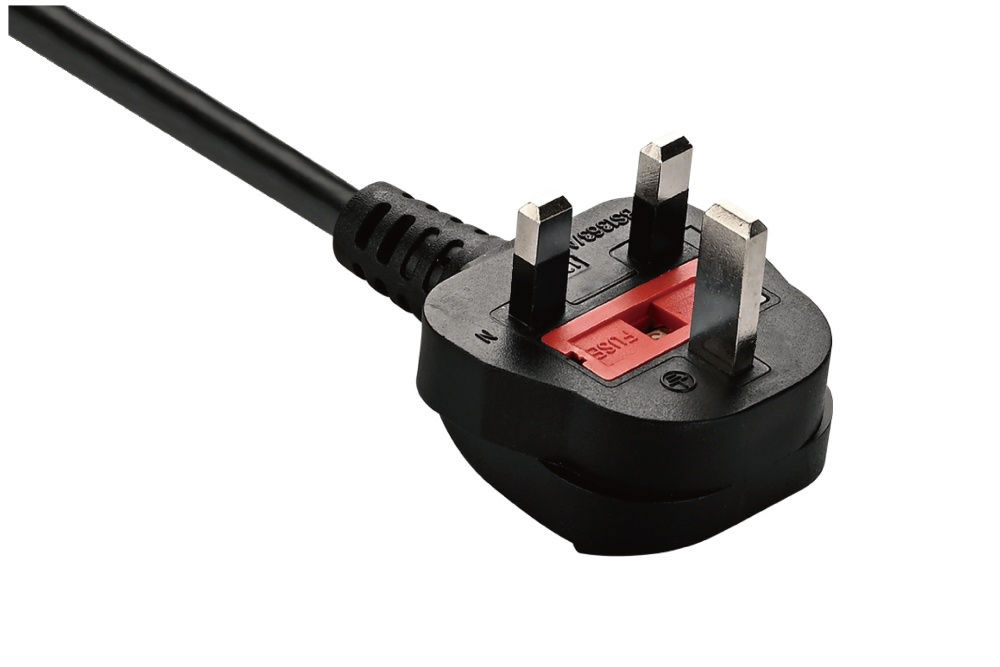
What Is a UK Power Cord?
A UK power cord is a flexible cable fitted with a BS 1363 Type G plug: the three-pin rectangular-pin plug with an integrated fuse used in the United Kingdom, Ireland (national standard I.S. 401) and other BS 1363 markets such as Hong Kong, Singapore, Malaysia and Saudi Arabia. It also goes by UK mains lead, BS 1363 cord or, where a C13 end is fitted, "kettle lead".
The defining feature of the Type G system is the BS 1362 cartridge fuse inside the plug head. Every UK cord is individually protected at the plug, which no other mainstream plug system does: EU Schuko (CEE 7/7) and US NEMA 5-15 plugs carry no fuse, so the protection sits in the appliance or in the distribution board instead.
UK cords run on 230 V AC, 50 Hz and are built to BS 1363-1, the part of the BS 1363 series that specifies rewirable and non-rewirable 13 A fused plugs: including the insulated sleeves on the live and neutral pins, the fuse interface, the cord grip, the marking and the type tests. The plug is limited to 13 A, about 3 kW at 230 V.
UK Power Cord Quick Facts
- Plug: BS 1363 Type G, three rectangular pins (earth at the top), 13 A / 250 V maximum, marked BS 1363 for normal use or BS 1363/A for rough use
- Fuse: BS 1362 plug-top cartridge fuse, 3 A, 5 A, 7 A, 10 A or 13 A at 250 V
- Mains: 230 V, 50 Hz; maximum 13 A ≈ 3 kW per cord
- Plug types: molded (non-rewirable) and rewireable, both available with ASTA or BSI Kitemark approval
- Connector ends: IEC 60320 C5, C7, C13 (straight, left or right angle), C14, C15, C19 and C20, locking and open-end terminations; IEC 60309 industrial plugs where 16 A or three-phase power is needed
- Cable: PVC H05VV-F or rubber H05RR-F / H05RN-F / H07RN-F, 2-core or 3-core, 0.5 mm² to 1.5 mm²
- Compliance: BS 1363-1, Plugs and Sockets etc. (Safety) Regulations 1994, ASTA Diamond Mark, BSI Kitemark, UKCA for Great Britain (CE continues to be recognized in Northern Ireland)
Key Features of the BS 1363 Type G Plug
- Three rectangular pins, earth at the top with live and neutral below, so the plug cannot be inserted inverted
- Insulated sleeves on the live and neutral pins, so a partly inserted pin cannot be touched
- Replaceable BS 1362 fuse in the plug head, rated 3 A to 13 A
- Socket shutters that open only when the earth pin pushes them apart
- Molded cord grip / strain relief at the plug base to protect the conductors
- Two duty categories: BS 1363 for normal use and BS 1363/A for rough use, marked on the plug body
Molded vs Rewireable UK Plugs
Both plug types use the same BS 1362 fuse and both are certified to BS 1363-1, but they suit different stages of production. The decision is where the cord is terminated: in the factory or on site.
| Feature | Molded (non-rewirable) | Rewireable |
|---|---|---|
| Construction | Plug body molded onto the cable; fuse and cord grip sealed into the plug | Plug opens on a single screw; conductors clamped in screw terminals |
| Rating | Marked according to the cable and fuse fitted, so not always 13 A | 13 A, 250 V |
| Fuse | Factory-fitted BS 1362 cartridge, matched to the cable | BS 1362 cartridge, replaceable by the user |
| Approval | Certified as part of the complete cord set (ASTA Diamond Mark or BSI Kitemark) | Plug certified separately; the finished lead depends on correct assembly |
| Best for | OEM production and appliances shipped ready to plug in; tamper-resistant and consistent | Field repairs, retrofits, prototypes and one-off lengths |
| Watch out for | New configurations need a new molding tool and lead time; the marking caps the maximum current | A wrongly re-wired plug (wrong fuse, loose terminals or a missing cord grip) is a fire risk and voids the approval |


For export orders UK cords are normally supplied with molded plugs, because the approval applies to the complete assembly: plug, cable, fuse and connector tested together. Rewireable plugs are the practical choice when the customer terminates the cord in their own factory or needs a length that cannot be pre-molded.
Certifications & Compliance
A BS 1363 cord has to clear two separate bars: the legal regime for plugs placed on the UK market, and the certification marks that buyers and retail chains ask for. The legal route is the Plugs and Sockets etc. (Safety) Regulations 1994, which require 13 A plugs to comply with BS 1363; UK authorities accept third-party approval of three-pin plugs by an accredited body, which is why the ASTA Diamond Mark is the mark you will see on most UK cord certificates.





| Certification | What It Covers | Why It Matters |
|---|---|---|
| BS 1363-1 | The British Standard for rewirable and non-rewirable 13 A fused plugs (pins, fuse interface, cord grip, marking, tests). It is Part 1 of a five-part series covering plugs, socket-outlets, adaptors, connection units and conversion plugs. Current edition: BS 1363-1:2023. | The specification the whole UK plug system is built on. Ask which edition a certificate cites, and whether it covers rewirable, non-rewirable or both. |
| BS 1363 vs BS 1363/A | BS 1363-1 defines two duty categories. Normal-use plugs are marked BS 1363; rough-use plugs are marked BS 1363/A and are built for equipment that is plugged and unplugged frequently. | Explains the "1363/A" on most UK cord certificates and catalog listings. Specify the category your market expects, and keep the marking consistent between plug, certificate and label. |
| ASTA Diamond Mark | Independent third-party certification of plugs, connectors and fuse links, issued by Intertek under the ASTA scheme. | One of the few marks UK authorities accept for three-pin plugs; it satisfies the approval requirement for BS 1363 plugs and is recognized in more than 40 countries. |
| BSI Kitemark | BSI's product certification licence for plugs and fuse links (plug and fuse licences are issued separately). | Voluntary but the strongest buyer-recognition mark in the UK: it certifies both the plug and the ongoing production audit. |
| UKCA | UK Conformity Assessed marking for goods placed on the Great Britain market. CE marking continues to be recognized for Northern Ireland. | Declare on the product and packaging and keep the Declaration of Conformity on file; most UK buyers ask for it with the certificate. |
| Plugs & Sockets Regs 1994 | Consumer-protection law (SI 1994/1768) covering 13 A plugs, socket-outlets, adaptors and fuse links placed on the UK market. | The legal basis for the BS 1363 requirement: non-compliant plugs cannot legally be sold in the UK. |
| BS 1362 | The standard for the plug-top cartridge fuse links used in BS 1363 plugs, up to 13 A. | A cord can only carry a Kitemark if its fuse does. Check the fuse marking, not just the plug. |
| RoHS / REACH / PAHs | Restricted substances in PVC compounds, plastics and cable materials, plus PAH limits for rubbers and hand-contact parts. | Standard requirement in UK and EU tenders and retail specifications. Request test reports per cable compound, not just per cord. |
Specifications & Ratings
Four variables define a UK cord: fuse rating, cable gauge, cable type and connector end. The fuse protects the cable, so the four have to agree. A 13 A fuse on 0.75 mm² cable is a mismatch, not a safety margin.
Fuse Ratings (BS 1362)
| Fuse Rating | Colour Code | Max Load at 230 V | Typical Applications |
|---|---|---|---|
| 3 A | Red | ≈ 690 W | Table lamps, chargers, routers, TVs, low-power electronics |
| 5 A | Black | ≈ 1,150 W | Radios, audio units, small appliances, desk equipment |
| 7 A | Usually black* | ≈ 1,600 W | Mid-power appliances, sold infrequently; check the marking |
| 10 A | Usually black* | ≈ 2,300 W | Larger appliances and commercial equipment below 13 A |
| 13 A | Brown | ≈ 3,000 W | Kettles, heaters, washing machines, PCs, servers, industrial equipment |
*Only 3 A (red), 5 A (black) and 13 A (brown) are consistently colour-coded; 7 A and 10 A links are commonly supplied black, so always read the marking rather than the colour. The fuse protects the cord, not the appliance: fit the smallest rating above the appliance's steady current and never up-rate a fuse to stop nuisance blowing.
Cable Gauge and Harmonized Code
| Cable Type | Cores | Size | Rating | Fuse Pairing |
|---|---|---|---|---|
| H03VVH2-F / H05VVH2-F | 2-core flat | 0.5 mm² (20 AWG) | 3 A | 3 A |
| H05VV-F / H05RR-F | 2 or 3-core | 0.75 mm² (18 AWG) | 6 A | 3 A or 5 A |
| H05VV-F / H05RN-F | 2 or 3-core | 1.0 mm² (17 AWG) | 10 A | 5 A or 10 A |
| H05VV-F / H05RN-F / H07RN-F | 2 or 3-core | 1.5 mm² (15 AWG) | 16 A | 13 A |
A 2-core cord (live + neutral, no earth) suits Class II double-insulated equipment such as laptop supplies, audio gear and lamps with a C5, C7 or lamp-holder end. A 3-core cord adds the earth conductor for Class I equipment: computers, servers, kitchen appliances and machinery.
Cable Jacket Types
| Jacket | Designation | Best For | Temperature |
|---|---|---|---|
| PVC | H05VV-F (H05VVH2-F flat) | Indoor office and appliance cords; the default for UK leads | 70 °C |
| Rubber | H05RR-F / H05RN-F | Outdoor, cold, wet or rough handling; light industrial and tools | 60–70 °C |
| Heavy rubber | H07RN-F | 16 A loads, long runs, worksites and industrial equipment | 60–85 °C |
| Silicone / braided / LSZH | Special compounds | High-temperature appliances, visible lamp cords and low-smoke public-building spec | as specified |
Jacket choice for a specific product, plus 2/3/4/5-core configurations and color options, is covered step by step in the custom power cord guide.
Connector Ends
| Connector | Standard | Cores / Rating | Typical Device |
|---|---|---|---|
| IEC C13 | IEC 60320 | 3-core / 10 A | PC towers, monitors, printers, most IT equipment; the default UK cord |
| IEC C13 left / right angle | IEC 60320 | 3-core / 10 A | Wall-mounted screens and equipment where a straight plug does not fit |
| IEC C14 | IEC 60320 | 3-core / 10 A | The matching inlet end: edge cords and C13-to-C14 jumper leads |
| IEC C5 | IEC 60320 | 2-core / 2.5 A | Laptop and notebook power supplies, small chargers (cloverleaf) |
| IEC C7 | IEC 60320 | 2-core / 2.5 A | Class II audio, video, set-top boxes and consoles (figure-8) |
| IEC C15 | IEC 60320 | 3-core / 10 A, 120 °C | Kettles, urns, cookers and other high-temperature appliances |
| IEC C19 | IEC 60320 | 3-core / 16 A | Servers, UPS units, PDUs and rack equipment above 10 A |
| IEC C20 | IEC 60320 | 3-core / 16 A | Matching inlet for C19 leads (PDU and appliance sockets) |
| Locking C13 / C19 | IEC 60320 | 3-core / 10–16 A | Data-center leads that must not work loose under vibration |
| Open end | n/a | 2 or 3-core / by fuse | Stripped, tinned or crimp-terminated for OEM harnesses and terminal blocks |
| IEC 60309 | IEC 60309 | 16 A / 32 A, 2P+E to 3P+N+E | Industrial and three-phase supplies, used where BS 1363 cannot carry the load |


Every BS 1363 cord is capped at 13 A by the plug fuse, so a C19 cord still delivers at most 13 A (≈ 3 kW) even though the connector is rated 16 A.
Other terminations such as receptacles, switches and lamp holders are covered in the wire end options guide →
Standard Lengths
Common production lengths are 1 m, 1.5 m, 1.8 m (6 ft), 2 m and 3 m, with custom lengths to order. For a full 13 A / 3 kW load keep the cord at or below about 5 m and stay on 1.5 mm² 3-core cable; beyond that, voltage drop raises the current for the same power and the cable runs warmer. Longer leads (10 m and above) should be specified for lower-power loads or in a heavier gauge.
UK vs EU vs US Power Cords: What's the Difference?
| Feature | UK (BS 1363 / Type G) | EU (Schuko / Type F) | US (NEMA 5-15P / Type B) |
|---|---|---|---|
| Voltage | 230V | 230V | 120V |
| Frequency | 50Hz | 50Hz | 60Hz |
| Plug Standard | BS 1363 Type G | CEE 7/7 (Schuko) Type F | NEMA 5-15P Type B |
| Integrated Fuse | ✓ Yes (3 A–13 A, BS 1362) | ✕ No | ✕ No |
| Max Current | 13A (3,000W) | 16A (3,680W) | 15A (1,800W) |
| Pin Shape | Rectangular (3 pins) | Round (2 pins + earth clips) | Flat (2 pins + round earth) |
| Key Certification | ASTA Diamond, BSI Kitemark, UKCA | CE, VDE, NF | UL, cUL, ETL |
| Interchangeable? | No, each requires a different socket and adapter for cross-region use | ||
The Type G family is wider than the UK alone: Ireland (I.S. 401), Hong Kong, Singapore, Malaysia and the Gulf markets use the same socket, though some also require their own national mark. Because the fuse sits in the plug, a UK lead can be safely re-fused for a smaller appliance, an option no Schuko or NEMA cord offers.
Common Applications
IT & Data Centers
Server, UPS, PDU and network leads on 1.5 mm² 3-core cable with a 13 A fuse, terminated with C13, locking C13 or C19 connectors. The plug fuse caps the cord at 13 A, so 16 A racks are fed from IEC 60309 instead.
Home Appliances
Kettles, toasters, microwaves, washing machines and refrigerators, normally 1.0–1.5 mm² with a 13 A fuse, and a C15 connector where the appliance end runs hot.
Medical Equipment
Hospital-grade UK leads with C13 or C19 ends, molded plugs and traceable fuse and cable documentation for hospital procurement.
Industrial & OEM
Custom lengths with stripped, tinned or crimp-terminated ends, rubber or heavy-rubber cable for rough handling, and IEC 60309 plugs where the load exceeds 13 A or is three-phase.
Looking for Certified UK Power Cords?
ChengBang builds BS 1363 plugs in molded and rewireable versions for the UK market, with IEC 60320 C5, C7, C13, C14, C15, C19 or C20 ends, RoHS/PAHs/REACH compliant, in standard or custom specifications with OEM/ODM support. See UK ASTA 1363/A power cords, with IEC 60320 C5, C7, C13, C14, C15, C19 and C20 ends, RoHS/PAHs/REACH compliant, in standard or custom specifications with OEM/ODM manufacturing support.