Power Cords Supplier, Manufacturer In China

American UL EV Charging Cables

EV cable is the UL 62 flexible cable family used to carry power and signal between a charging station and the vehicle, and it also appears in UL 2263 EV cable listings and NEC article 625 equipment. Four types cover the North American market: EVE and EVJE with thermoplastic elastomer insulation and jacket, and EVT and EVJT with PVC insulation and jacket. The letter J marks the 300V version, so EVJE and EVJT are rated 300V while EVE and EVT are rated 600V. All four are 105°C cables built on 18 to 6AWG fully annealed stranded copper, normally as three power conductors plus a ground, and they pass the UL VW-1 vertical flame test. TPE suits cold, abrasion and chemical exposure; PVC is the economical choice for home charging leads.
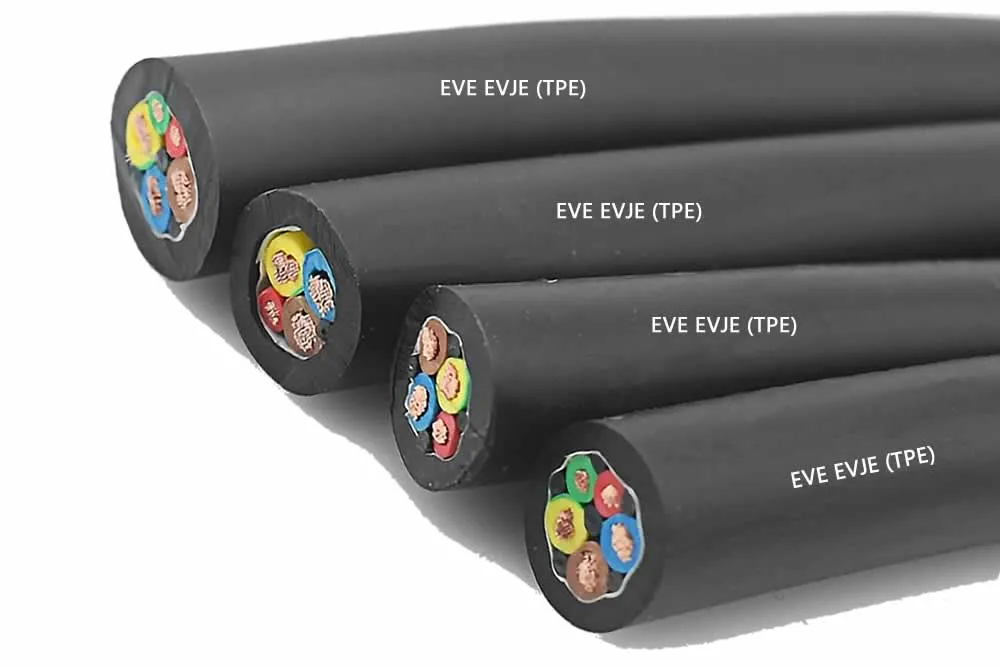
EVE, EVJE, TPE Insulated EV Charging Cable, 600V and 300V

EVE, EVJE, TPE Insulated EV Charging Cable, 600V and 300V

Types EVE and EVJE are the thermoplastic elastomer versions of the UL 62 EV charging cable, and the letter J is the only structural difference between them: EVJE is the 300V type and EVE is the 600V type. Both use colour coded 105°C TPE insulation and a black 105°C TPE jacket over 18AWG to 6AWG fully annealed stranded copper, and both stay flexible from -50°C up to 105°C dry with a 60°C wet rating, passing the UL VW-1 vertical flame test. The TPE jacket is lighter than a PVC jacket at the same gauge, resists abrasion, oil and chemicals better, and can be bonded to the connector overmould, which is why it is the usual choice for commercial charging leads and outdoor installations.
Rating:
600V (EVE), 300V (EVJE)
Plug Type:
-50°C to +105°C, 60°C wet
Connector Type:
UL, cUL
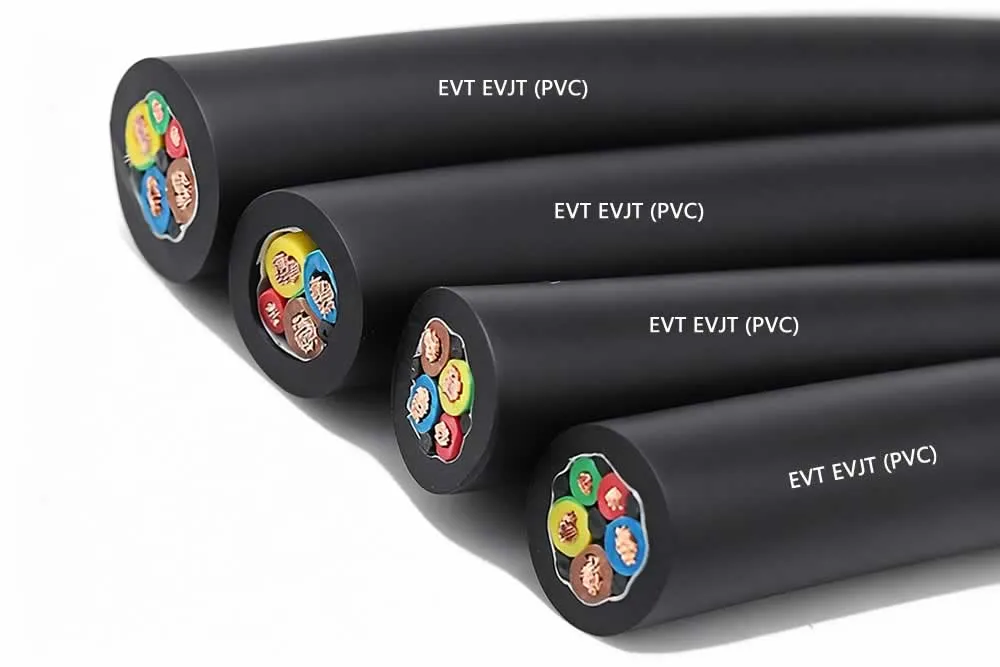
EVT, EVJT, PVC Insulated EV Charging Cable, 600V and 300V

EVT, EVJT, PVC Insulated EV Charging Cable, 600V and 300V

Types EVT and EVJT are the PVC insulated members of the UL 62 EV charging cable family, and as with the elastomer pair the J marks the 300V version: EVJT is 300V and EVT is 600V. Conductor range, 3 plus ground layout, 105°C rating, 60°C wet rating and VW-1 flame performance are shared with the TPE types, while the PVC insulation and black PVC jacket put the cold limit at -40°C instead of -50°C and give a stiffer, heavier cable at the same gauge. That is the trade for cost: PVC is the economical jacket in the line and the usual specification for portable and residential charging leads that stay indoors or in a garage and are not dragged across a forecourt.
Rating:
600V (EVT), 300V (EVJT)
Plug Type:
-40°C to +105°C, 60°C wet
Connector Type:
UL, cUL

Frequently Asked Questions

Common questions about American UL EV Charging Cables

Four UL 62 types in two material families: EVE and EVJE with thermoplastic elastomer insulation and jacket, and EVT and EVJT with PVC insulation and jacket. The J types are the 300V versions and the plain types are 600V, so one material family covers both system voltages.

It is built for repeated handling and outdoor service rather than for a fixed appliance: heavier jacket walls, a flexible stranded conductor in every core, oil and abrasion resistant compounds, wet ratings and the UL VW-1 vertical flame test, at 300V or 600V and 105°C.

Charging cables are dragged, coiled and left outside, so the jacket compounds are chosen for cold flexibility, abrasion, oil and sunlight. TPE covers the harshest duty down to -50°C; PVC covers the cost-sensitive home charging lead down to -40°C.

It marks the 300V version of the type, in the same way the J in SJ or SJO marks the junior 300V flexible cord in UL 62. EVE and EVT are the 600V versions of the same two constructions.

The cable is supplied on its own for charger builders who fit their own connector, and it can also be built into a finished charging lead with the connector overmoulded, with the TPE jacket giving a stronger bond to the overmould than PVC.

Online Inquiry

Subject: Loading...
Captcha
E-mail If you have images or attachments, please email us.