
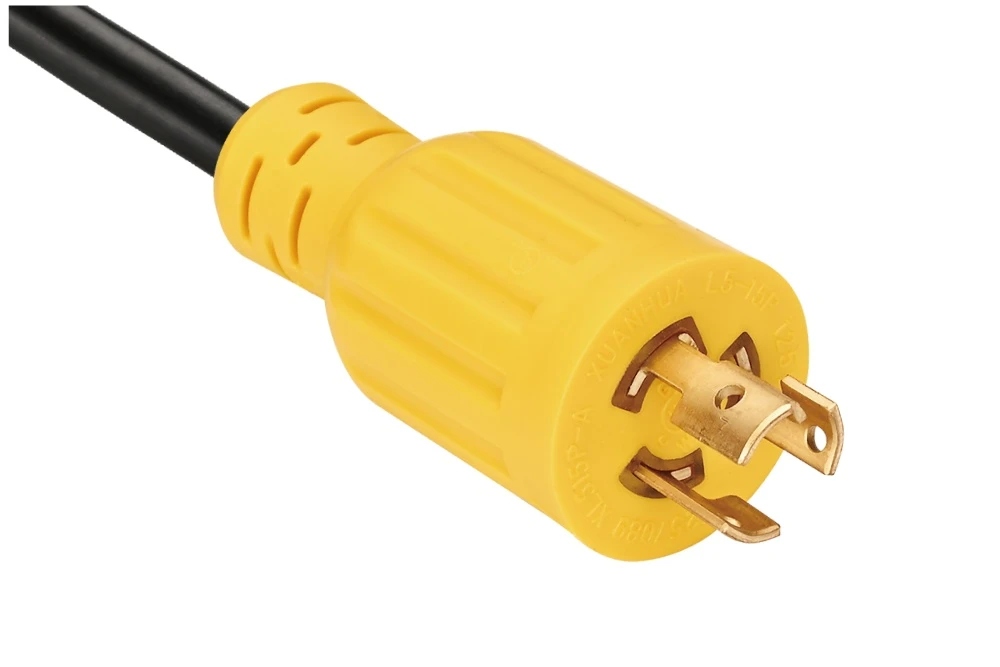
What Is a Twist Locking Cord?
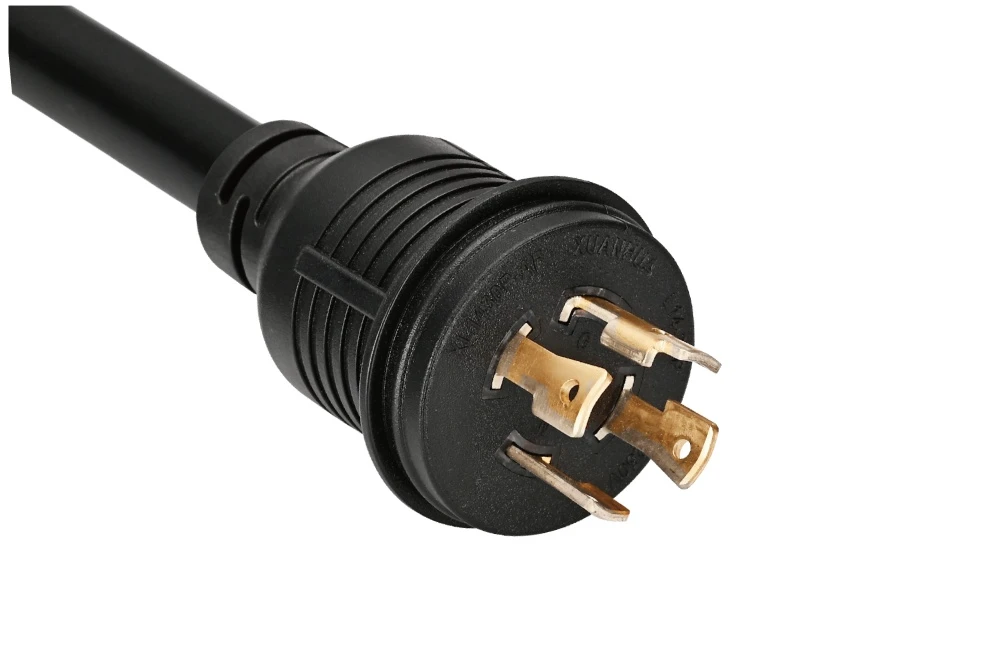
A twist-locking cord has a plug whose blades are curved rather than straight. The plug goes straight into the receptacle and then turns, and the curved blades seat behind matching shoulders inside the device so the connection cannot be broken by pulling along the axis of the plug. NEMA identifies these configurations with an L before the code, so L5-15 is the locking version of the 15 A 125 V family and L14-30 is the locking version of the four-wire 30 A dryer circuit.
The ratings are the same as the straight-blade families they mirror: same voltage, same amperage, same pole and wire count. What changes is the interface. A 5-15P will not enter an L5-15R, and an L5-15P will not enter a 5-15R. That physical separation is deliberate, and it means a locking cord is never a substitute for a straight-blade cord when the receptacle on the wall is the flat two-blade type.
Where the requirement comes from: locking plugs appear wherever a disconnected cord stops the job. Portable generators, temporary power distribution, server racks, stage lighting and marina shore power all specify them, and some equipment standards require a locking connection for the cord that feeds the machine.
How the Lock Works
The lock is entirely mechanical. The ground pin or the shell acts as the key that only lets the plug enter in one orientation, the curved blades pass through the receptacle's openings, and rotating the plug moves those blades behind the retention shoulders. Spring tension in the receptacle contacts then holds the plug against the shoulders, so pulling on the cord loads the locking surfaces instead of the contact surfaces.
Two consequences follow from that design. The first is that the plug cannot be removed by pulling; it has to be rotated back before it will release, which is why equipment is normally shipped with the cord tied or clipped so the plug is not rotated in transit. The second is that the contacts stay under spring pressure in a fixed position, so the connection is less prone to the small movements that build up heat over years of vibration.
L-Series Configurations
The table below lists the locking configurations we mold. Single-phase 125 V and 250 V families cover most equipment; the 277 V and three-phase families cover commercial lighting, server racks and industrial machinery. Marine shore power has its own two designs at the bottom of the table.
| Configuration | Rating | Poles / wires | Typical use |
|---|---|---|---|
| L5-15P / L5-15R | 15 A, 125 V | 2-pole, 3-wire | Stage and studio equipment, UPS outlets, small PDUs |
| L5-20P / L5-20R | 20 A, 125 V | 2-pole, 3-wire | 20 A rack PDUs, portable tools, pumps |
| L5-30P / L5-30R | 30 A, 125 V | 2-pole, 3-wire | 30 A RV pedestals, larger single-voltage equipment |
| L6-15P / L6-15R | 15 A, 250 V | 2-pole, 3-wire | 240 V stage lighting, heaters, compressors |
| L6-20P / L6-20R | 20 A, 250 V | 2-pole, 3-wire | Rack PDUs, air conditioners, commercial kitchen equipment |
| L6-30P / L6-30R | 30 A, 250 V | 2-pole, 3-wire | UPS input and output, 240 V machines |
| L7-15P / L7-20P | 15 A to 20 A, 277 V | 2-pole, 3-wire | Commercial lighting on 277 V circuits |
| L8-20P / L8-30P | 20 A to 30 A, 480 V | 2-pole, 3-wire | High-voltage single-phase industrial equipment |
| L14-20P / L14-20R | 20 A, 125/250 V | 3-pole, 4-wire | 240 V equipment needing a neutral |
| L14-30P / L14-30R | 30 A, 125/250 V | 3-pole, 4-wire | Portable generator inlets and outlets, transfer switches |
| L15-20P / L15-30P | 20 A to 30 A, 250 V | 3-pole, 4-wire | Three-phase 250 V machinery |
| L18-30P | 30 A, 120/208 V | 3-pole, 4-wire | Three-phase 208 V distribution |
| L19-30P | 30 A, 277 V | 3-pole, 4-wire | Three-phase 480/277 V distribution |
| L21-20P / L21-30P | 20 A to 30 A, 120/208 V | 4-pole, 5-wire | Data center three-phase PDUs with neutral |
| L22-20P | 20 A, 277 V | 4-pole, 5-wire | Three-phase lighting and rack distribution |
| L23-20P / L23-30P | 20 A to 30 A | 4-pole, 5-wire | Three-phase distribution, high-current rack feeds |
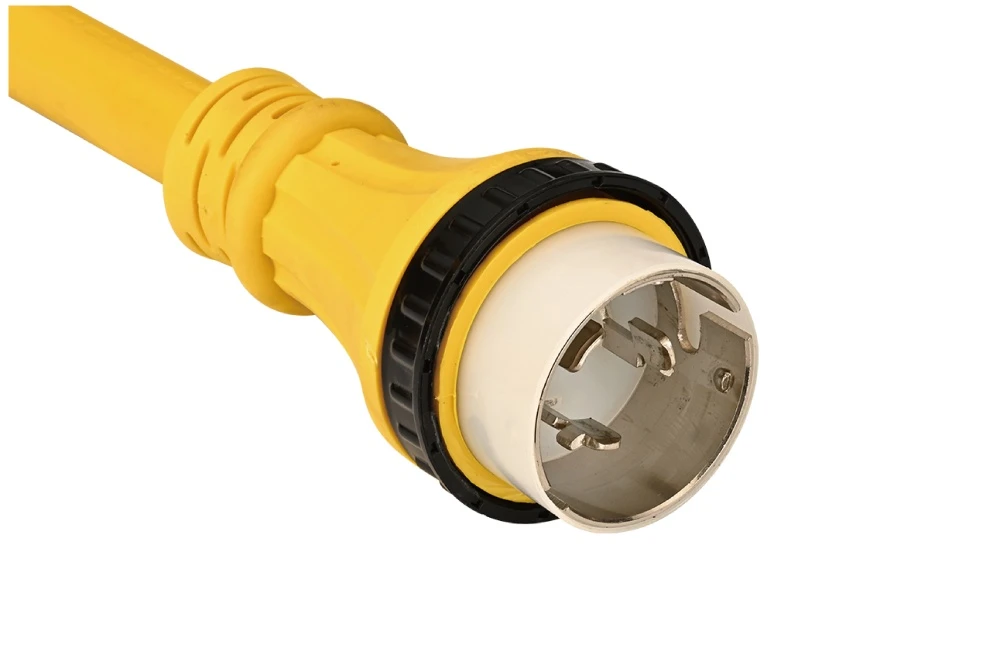
| SS1-50P / SS1-50R | 50 A, 125 V | 2-pole, 3-wire | Marine shore power, 50 A single voltage |
| SS2-50P / SS2-50R | 50 A, 125/250 V | 3-pole, 4-wire | Marine shore power with 125 V and 250 V on board |
The L24, L16 and L20 families are also tooled. If your equipment plate names a configuration that is not in this table, send the photo of the nameplate and we will confirm the mold.
Vertical Rib vs Ring Rib
Locking plugs are gripped and turned by hand, so the body carries either vertical ribs along its length or a ring around its middle. Both are UL, ETL and cULus listed to the same ratings, and the choice is usually a matter of how the cord is handled in service.
| Body | Grip | Where it suits |
|---|---|---|
| Vertical rib | Ribs run along the body, giving a natural grip for a straight pull and turn | General locking cords, generator and rack cables, molded right-angle versions |
| Ring rib | A ring around the body gives a wider surface and a stronger turn | Higher-current 30 A and 50 A plugs, marine cords, gloved hands |
| Ergonomic | Shaped body with a thumb rest on one side | Cords handled many times a day |
| Right angle | Cable exits at 90 degrees to the blades | Racks, generator panels, tight enclosures |
| Transparent | Clear body shows the terminals | Inspection and demonstration units |
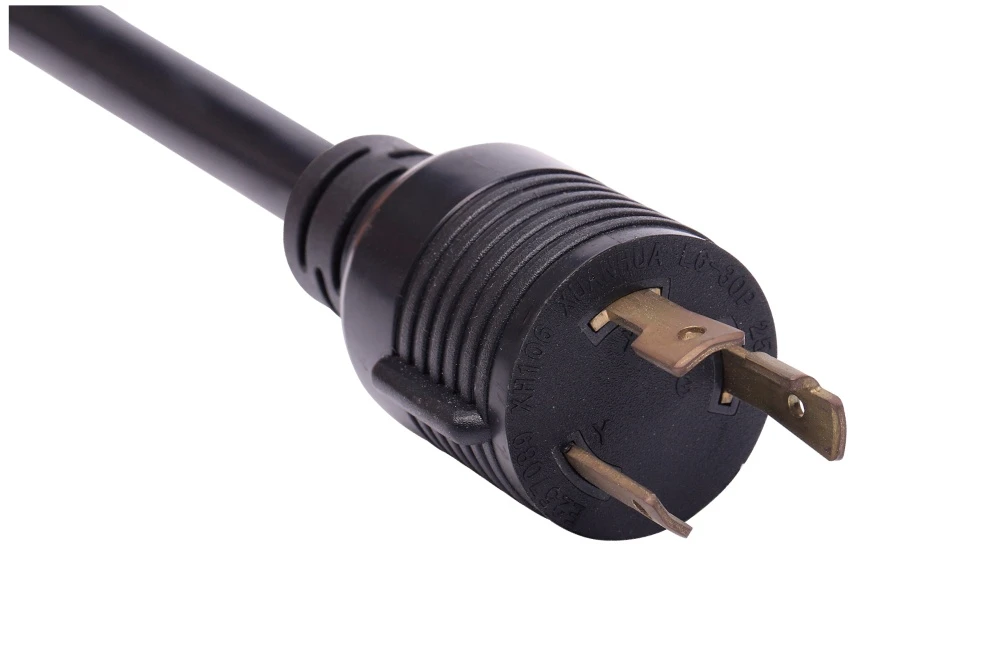
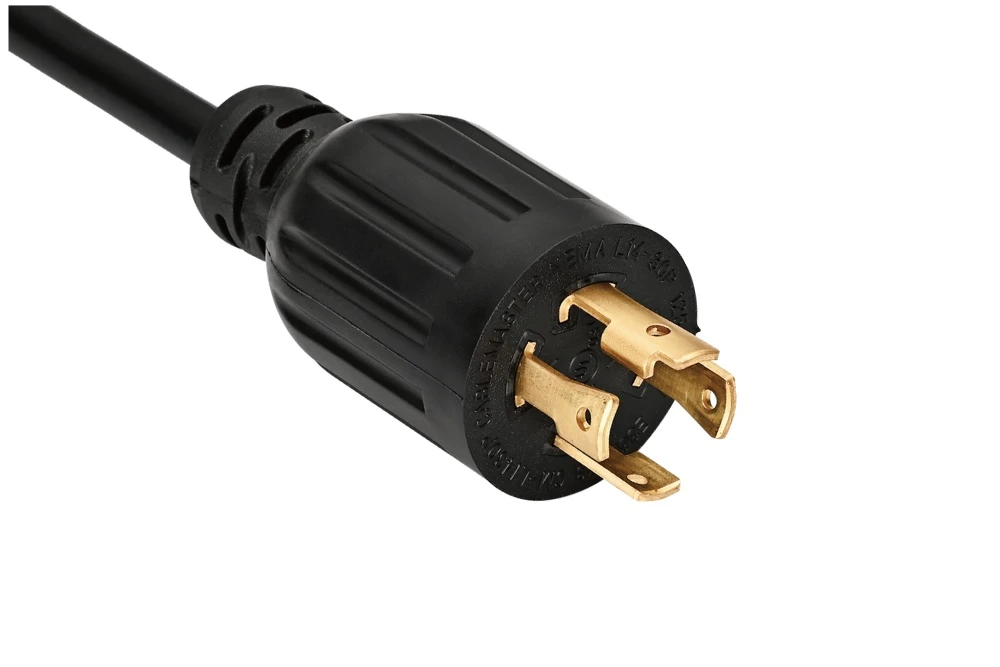
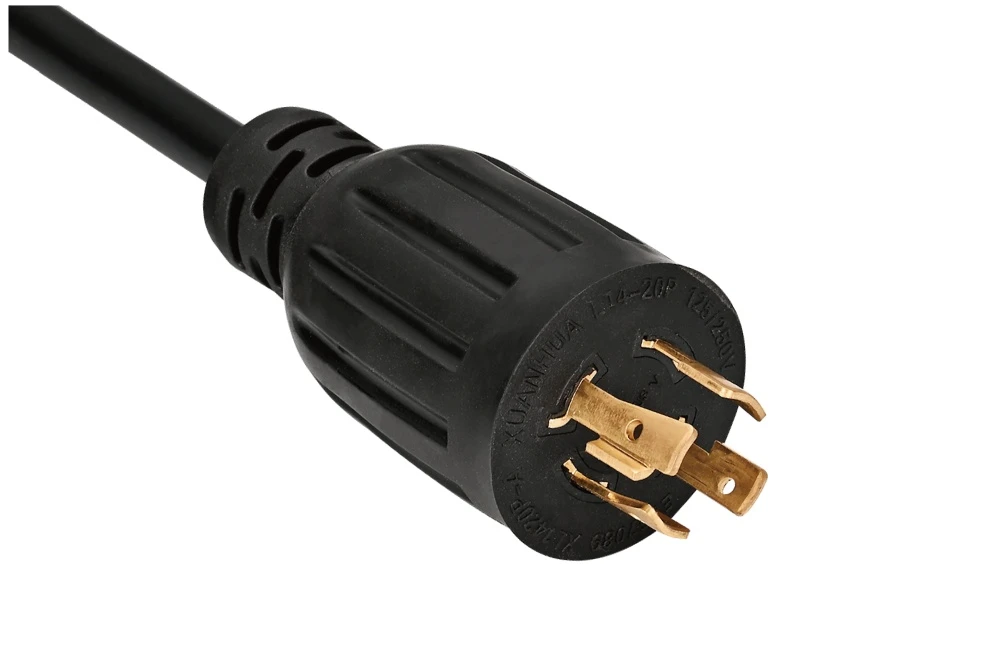
Locking cords are common outdoors, so the same bodies are molded with a sealed cover over the blade face and a gasket at the cable entry. The result is a cord rated IP44: protected against solid objects down to 1.0 mm and against water sprayed from any direction. That covers rain, washdown splash and marina spray, and it does not cover immersion.
Waterproof locking versions are stocked in L5-15, L5-30, L6-15, L6-30, L7-15 and L14-30, along with the two shore power plugs. Marine cords use tinned copper and a jacket formulated for salt water and sunlight, because a standard jacket will harden and crack in a marina environment long before the electrical parts wear out.
Details on sealing, IP ratings and outdoor cable are in the IP44 waterproof power cord guide.
Cable and Ratings
The cable is selected from the current rating and the environment. Locking cords above 20 A are usually built on SJTW or SOOW, and marine cords on a tinned copper shore power cable with a weather-resistant jacket.
| Rating | Typical conductor | Cable type |
|---|---|---|
| 15 A, 125 V to 250 V | 14 AWG, 3-conductor | SJT, SJTW, SOOW |
| 20 A, 125 V to 250 V | 12 AWG, 3-conductor | SJT, SJTW, SOOW |
| 30 A, 125 V to 250 V | 10 AWG, 3 or 4-conductor | SJTW, SOOW |
| 50 A, three-phase | 8 AWG to 6 AWG, 5-conductor | SOOW |
| 50 A shore power | 8 AWG to 6 AWG, 3 or 4-conductor | Marine shore power cable, tinned copper |
Voltage drop matters more on locking cords than on appliance cords, because generator and pedestal runs are long. A 30 A cord running 25 m at 10 AWG loses noticeably more voltage than the same cord at 8 AWG, and the equipment at the far end is often a motor that draws more current as the voltage falls. Tell us the run length and we will quote the gauge that keeps the drop within limits.
Connector Ends
A locking cord is ordered by its two ends. The L-series plug locks into the outlet, and the far end is whatever the equipment or the next cable needs, molded on the same lead.
| Connector end | Standard | Typical use |
|---|---|---|
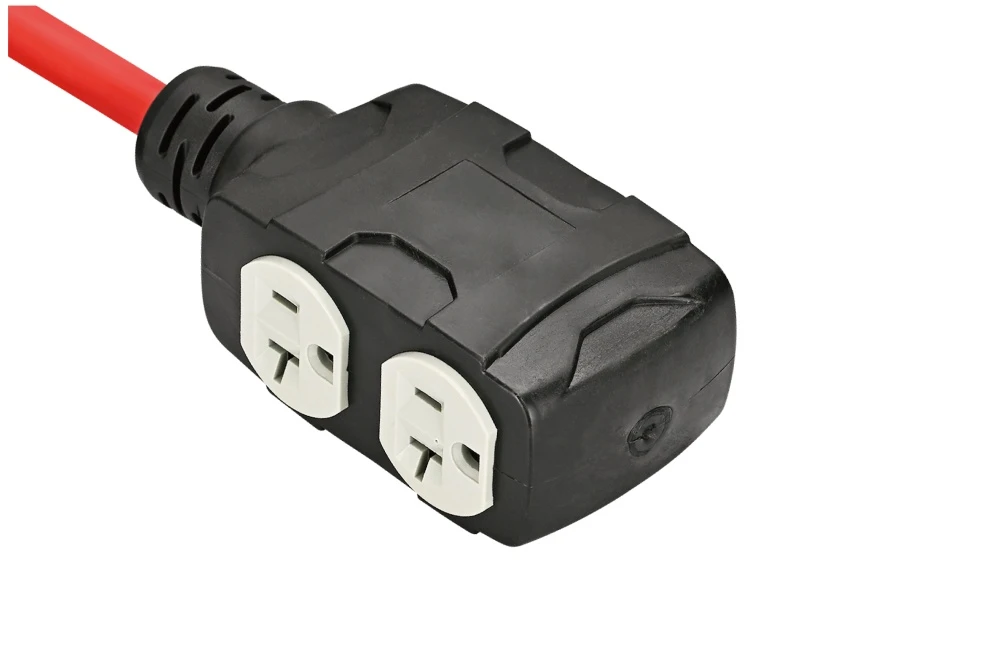
| L5-15R / L5-20R | NEMA WD 6 | Matching twist locking outlet on tools, pumps and temporary lighting |
| L5-30R | NEMA WD 6 | 30 A 125 V loads and transfer panels |
| L6-20R / L6-30R | NEMA WD 6 | 250 V machinery, compressors and welders |
| L14-30R / L14-50R | NEMA WD 6 | Generator inlets, transfer switches and RV pedestals |
| SS1-50R / SS2-50R | NEMA WD 6 | Marine shore power and 50 A RVs |
| 5-15R / 5-20R | NEMA WD 6 | Straight blade receptacle end on a locking plug cord |
| Locking C13 / C19 | IEC 60320 | Made to order for racks, PDUs and servers |
| Open end | n/a | Hard wired equipment, junction boxes and terminal blocks |
Locking C13 and C19 connectors are a stock line of their own, in straight, right-angle and left-angle bodies. Fitted to a twist locking cord they are a made-to-order end: send the plug, the far end and the cable and the assembly is molded to match.
Where They Are Used
| Application | Configuration | Why locking |
|---|---|---|
| Portable generators | L14-30, L5-30 | The inlet cord stays put while the generator vibrates |
| Data center racks and PDUs | L5-15, L5-20, L6-20, L21-20, L22-20 | A loose server feed is an outage that nobody can see |
| Stage and studio lighting | L5-15, L6-15, L6-20 | Truss-mounted fixtures are reached and bumped between shows |
| Marine shore power | SS1-50, SS2-50, L5-30 | Dock pedestals take spray and constant plugging |
| RVs and campers | L5-30, L14-30 | Long runs along a pitch, with the plug left hanging |
| Industrial machinery | L15-20, L16-20, L18-30, L19-30 | Three-phase motors vibrate continuously |
| Temporary site power | L14-30, L6-20 | Distribution boxes are moved while energized |
Locking vs Straight-Blade
| Feature | Straight-blade | Twist-locking |
|---|---|---|
| Insertion | Push in, friction holds the blades | Push in and rotate to seat the blades behind the retention shoulders |
| Retention | Contact friction only | Mechanical lock, released by rotating back |
| Vibration | Can work loose over time | Holds; movement is taken by the shoulders, not the contacts |
| Availability | Every hardware store, all ratings up to 50 A | Fewer retail sources; standard on racks, generators and marine equipment |
| Cost | Lower | Higher, because of the extra metal and molding |
| Substitution | Not interchangeable. The correct choice is the one matching the receptacle on the equipment or the wall. | |
Where the receptacle is already a locking type, the cord must match it. Where the wall has a standard flat receptacle and the equipment plug is straight-blade, replacing the cord with a locking one is not an upgrade; it is a mismatch that will not fit. The American power cord guide covers the straight-blade families in detail.
Ordering Notes
Locking configurations are molded to order in the body style, cable and length you specify, with UL, ETL and cULus certification. Because the molds exist for the ratings listed above, tooling cost is not normally involved for standard configurations.
Looking for NEMA Twist Locking Power Cords?
We mold L5, L6, L7, L8, L14, L15, L18, L19, L21, L22 and L23 locking cords, plus SS1-50 and SS2-50 marine shore power plugs, in vertical rib, ring rib, ergonomic, right-angle and waterproof bodies. Materials are UL, ETL and cULus listed, with RoHS, REACH and PAHs documentation available on request.
Typical MOQ is 200 to 1,000 pieces, samples ship in 7 to 15 days and production runs 15 to 20 workdays.