
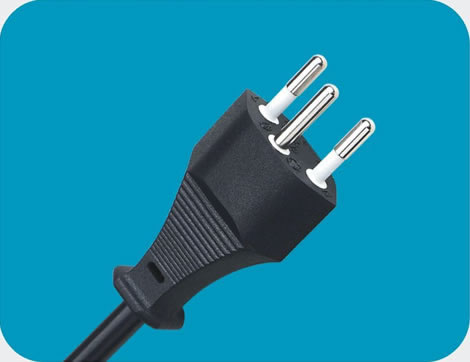
What Is a Swiss Power Cord?
A Swiss power cord is a flexible cord fitted with a plug to SN 441011, the national plug and socket standard of Switzerland, which took over from SEV 1011 on 1 March 2019. The same sockets are used in Liechtenstein. Mains is 230 V, 50 Hz, and the plugs are rated 250 V, 10 A or 16 A depending on type.
The three-pin plug is known internationally as Type J, and it is the one most buyers mean when they ask for a Swiss cord. What makes the system awkward to specify is that the Swiss have several plug bodies that look alike, are rated differently, and are not interchangeable in both directions. A cord that fits a modern kitchen socket is not automatically the right one for a 16 A appliance or for an outdoor pump.
The system is built to be hierarchically compatible: a 16 A socket accepts a 10 A plug, a five-pin three-phase socket accepts the single-phase 10 A and 16 A plugs, and the 2.5 A Europlug fits every Swiss socket. The reverse never applies. Once you know the appliance current and whether it is earthed, the choice narrows to one or two types.
Swiss Power Cord Quick Facts
- Standard: SN 441011 since 1 March 2019; SN SEV 1011 was withdrawn on 28 February 2022
- Mains: 230 V, 50 Hz; plugs marked 250 V; three-phase 250/440 V
- Plug types on cords: Type 11 (2-pin, unearthed, 10 A), Type 12 (3-pin, earthed, 10 A), Type 21 (2-pin, 16 A), Type 23 (3-pin, 16 A)
- Pins: 4 mm diameter, 19 mm long, with 8 mm of insulation on the pin since 1 January 2013
- Protection: IP20 as standard; a standardized IP55 plug and socket system was added in 2019 for outdoor work
- Cables: H03VV-F, H03VVH2-F, H05VV-F, H05VVH2-F, H05RR-F, H05RN-F, H07RN-F, usually 0.75 to 1.5 mm²
- Approval: SEV mark, with ESTI as the Swiss market surveillance authority
Plug Types 11, 12, 13, 15, 23 and 25
The standard numbers the plugs and the sockets separately, which is where most of the confusion starts. Only a few of these types end up on a power cord.
| Type | Poles | Rating | Where it is used |
|---|---|---|---|
| Type 11 | 2 (L + N) | 10 A, 250 V | Two-core leads for Class II appliances; unearthed |
| Type 12 | 3 (L + N + PE) | 10 A, 250 V | The three-pin earthed plug, the classic Type J |
| Type 13 | 3 (L + N + PE) | 10 A, 250 V | Recessed socket-outlet version of the same interface |
| Type 15 | 5 (3L + N + PE) | 10 A, 250/440 V | Three-phase, small machines and workshop equipment |
| Type 21 | 2 (L + N) | 16 A, 250 V | Two-core 16 A leads, unearthed |
| Type 23 | 3 (L + N + PE) | 16 A, 250 V | Earthed 16 A plug, square socket openings |
| Type 25 | 5 (3L + N + PE) | 16 A, 250/440 V | Three-phase 16 A |
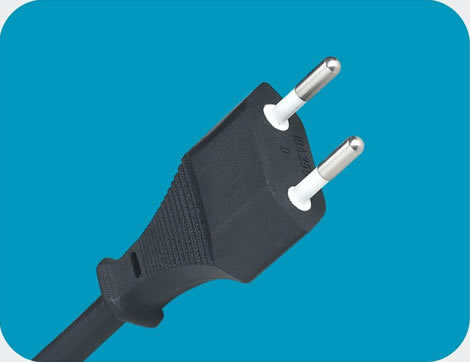
Type 12 and Type 13 are one interface, not two plugs
Type 12 describes the plug, Type 13 the recessed socket-outlet that receives it. When a drawing says "Type 13 plug" it normally means the standard three-pin 10 A plug, the Type 12 body. The distinction matters because older Type 12 sockets sat flat against the wall and left the live pins exposed while the plug was going in. Type 13 sockets are recessed, and since 1 January 2013 plugs entering Switzerland must also carry the 8 mm insulated sleeve on each pin. Modern Type 12 plugs into modern Type 13 sockets is the everyday combination.
10 A or 16 A
The 10 A types cover most domestic and office equipment. The 16 A types, Type 21 and Type 23, have square socket openings and only fit 16 A sockets. A 16 A socket takes a 10 A plug without an adapter, so if there is any chance the appliance will be upgraded, ordering the 16 A plug is the safer call, provided the appliance inlet can take it.
Swiss Plug to IEC Connector Cords
Most Swiss cords are not open-ended. They leave the factory with an IEC 60320 connector on the equipment side, and the seven combinations below cover the range we mold for Switzerland. The plug body stays the same; only the connector, its angle and the rated current change.


The two-pin Type 11 body is used with a C7 connector on double-insulated equipment, rated 2.5 A. Everything earthed runs a three-pin Type 12 plug: C13 straight or angled for appliances and IT, C5 for laptop adapters, C15 where the appliance end runs hot, and C19 for 16 A equipment such as servers and PDUs. Current is set by the connector and cable, not by the plug, so a 16 A C19 cord still uses the same 10 A plug body unless it is built on Type 23.
IP55 Waterproof Swiss Plugs
A standard Swiss plug is IP20: protected against fingers, nothing more. For outdoor and wet areas the 2019 standard added a standardized IP55 plug and socket-outlet system, where IP55 means dust-protected (IP5X) and protected against water jets from any direction (IPX5).
Two conditions come with that rating, and both are often missed in enquiries:
- IP55 applies only when an IP55 plug is mated with an IP55 socket-outlet. The same plug in an ordinary IP20 socket is not water-protected at the joint, even though the body itself stays sealed.
- IP55 is not IP67. Rain, hose-down and wash-down are fine; immersion is not.
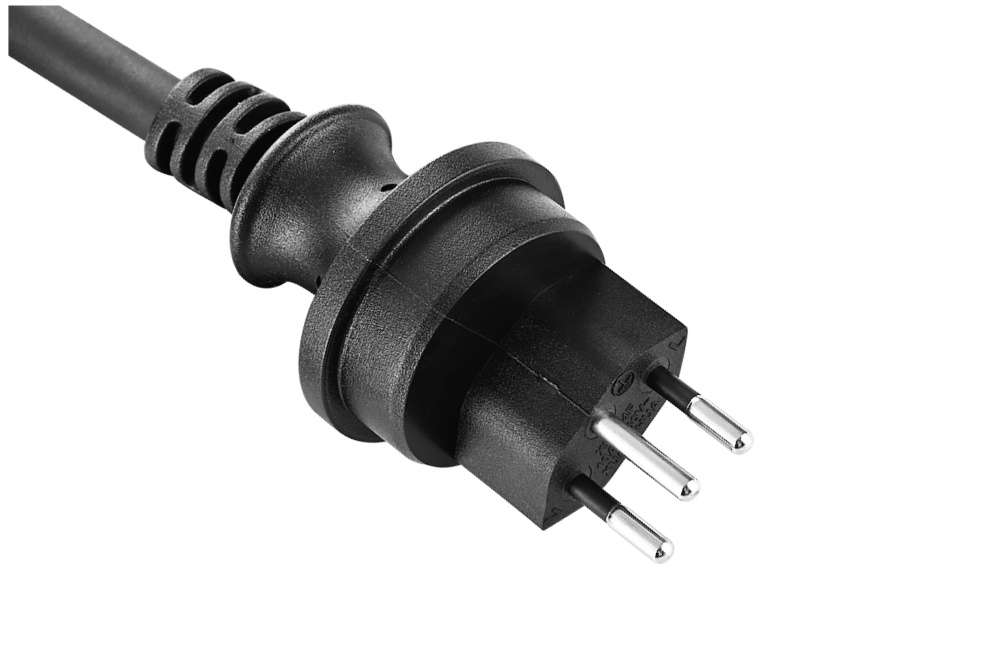
Molded IP55 plugs are normally supplied on rubber cable, commonly H05RN-F 3G1.0 for general use and H07RN-F 3G1.5 for heavier handling. The seal is the collar between the body and the boot: the plug is molded onto the jacket in one piece, so there is no joint for water to follow into the pins.
Transition from IP44. ESTI Communication 2020-0701 sets the periods after which the older IP44 products leave the market. IP44 plugs from the previous system are only partly compatible with IP55 socket-outlets, and mixing the two with an adapter is not permitted. A cord sold as IP44 should not be presented as IP55, and the reverse substitution is not automatic either.
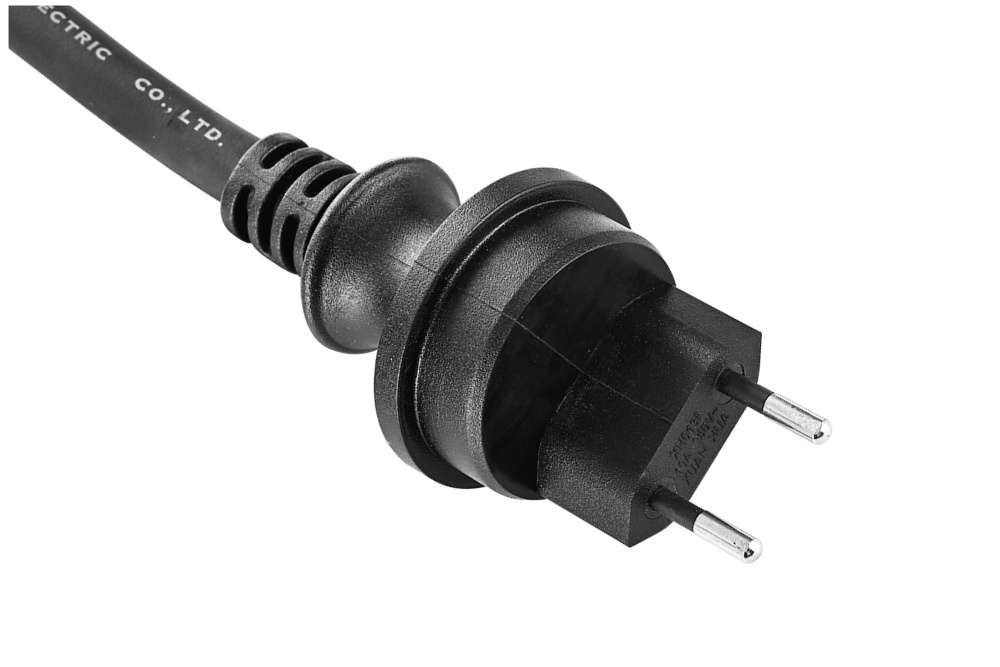
Two-pin sealed leads are also sold as IP55 by manufacturers, and in practice that is a rating of the sealed assembly rather than membership of the standardized IP55 system, which is specified around the earthed three-pin types. If the application is a Class II appliance and the data sheet says IP55, ask for the test report that goes with it.
Our own two Swiss sealed cords are built this way: a two-pin Type 11 IP55 lead for Class II equipment and a three-pin Type 12 IP55 lead with a full earth through the sealed body.
Cables and Ratings
Swiss cords are built on harmonized European cable codes, so the same jacket and conductor descriptions appear on a Swiss, German or Dutch order. What changes at the plug end is the body, the pin layout and the approval.
| Cable | Construction | Typical use on a Swiss cord |
|---|---|---|
| H03VVH2-F | Flat PVC, 2 core, 0.5 to 0.75 mm² | Light Class II appliances, indoor |
| H03VV-F | Round PVC, 2 or 3 core, 0.5 to 0.75 mm² | Small appliances, lamps |
| H05VVH2-F | Flat PVC, 2 core, 0.75 to 1.0 mm² | Double-insulated kitchen and household goods |
| H05VV-F | Round PVC, 2 or 3 core, 0.75 to 1.5 mm² | General purpose, the most common Swiss cord cable |
| H05RR-F | Rubber, 2 or 3 core, 0.75 to 1.5 mm² | Light rubber flex, workshop and garden |
| H05RN-F | Rubber, 2 or 3 core, 0.75 to 1.0 mm² | Outdoor use, often with the IP55 plug |
| H07RN-F | Heavy rubber, 2 to 5 core, 1.0 to 2.5 mm² | Pumps, tools, site equipment, three-phase |
Conductor size follows the load and the cable code, not the plug: a Type 12 plug appears on 0.75 mm² lamp leads and on 1.5 mm² appliance leads alike. The limits that matter in practice are 10 A for the Type 11, 12 and 13 family, 16 A for the Type 21, 23 and 25 family, and the temperature rating of the jacket, 70 °C for PVC and 60 °C for ordinary rubber.
At the equipment end, Swiss cords are usually terminated with an IEC 60320 connector (C5, C7, C13, C14, C15, C19 or C20), an IEC 60309 industrial plug for higher currents, or finished to the appliance drawing. The full set of alternatives is set out in power cord wire end options.
Certification and Compliance
A Swiss cord is approved against SN 441011 and carries the SEV mark. ESTI, the Federal Inspectorate for Heavy Current Installations, is the authority that publishes the standard's transition rules and polices the market, so the paperwork a buyer should ask for is the SEV certificate plus the test report to the current edition of the standard.
Switzerland is not an EU member. CE marking on an appliance does not replace the Swiss plug approval, and a cord approved only to EN standards without SEV is not the same product for the Swiss market. In practice most Swiss cords also use IEC 60320 connector ends built to EN 60320, so the connector carries its own approvals while the plug carries SEV.
Materials are the usual European baseline: RoHSREACHPAHS compliant compounds, with test reports available on request.
What Fits What
The Swiss system resembles the German Schuko system at a glance and is not interchangeable with it. This table covers the combinations that come up on incoming inspection and in after-sales questions.
| Combination | Fits? | Note |
|---|---|---|
| Europlug (2.5 A) into a Swiss socket | Yes | All Swiss socket types accept it |
| Type 11 or Type 12 plug into a Swiss 16 A or three-phase socket | Yes | Downward compatible |
| Type 23 plug into a 10 A Swiss socket | No | 16 A plugs need 16 A sockets |
| Swiss plug into a Schuko (CEE 7/7) socket | No | Different pin diameter and spacing |
| Schuko plug into a Swiss socket | No | Use a fixed adapter, not a cord substitution |
| IP55 plug into an IP20 socket | Mechanically yes | Loses the IP55 rating at the joint |
What to Specify on an Order
Six lines on a drawing remove most of the back-and-forth on a Swiss cord order:
- Plug type and current: Type 11, 12, 21 or 23, with 10 A or 16 A stated, plus IP55 if it is an outdoor lead.
- Cable: harmonized code and conductor size, for example H05VV-F 3G1.0 or H07RN-F 3G1.5.
- Length: measured from the plug face to the end of the connector or the stripped tail, not the overall bundle.
- Equipment end: connector type, angle, or termination such as stripped and tinned, ferrules, ring or fork terminals.
- Colour and marking: body and jacket colour, plus any print legend or approval text on the jacket.
- Documentation: SEV certificate, test report, RoHS and REACH declarations, and whether the batch needs traceability.
For custom lengths, colours and end finishes, the workflow is the same as any other market and is described in how to customize a power cord.
Common Applications
Kitchen and Household
Coffee machines, kettles, fondue and raclette sets, dishwashers. Mostly Type 12 on H05VV-F 3G0.75 to 1.0, with a C13 or a molded appliance end.
Outdoor and Garden
Pumps, mowers, hedge trimmers and lighting on H05RN-F or H07RN-F with the IP55 plug, used with an IP55 socket-outlet.
Cleaning Equipment
Wash-down machines and vacuums, three-core rubber cable, sealed plug, often with an angled connector at the appliance end.
IT and Office
Type 12 to C13 or C19 leads for servers and PDUs, H05VV-F 3G1.0 to 1.5, straight or angled C13 bodies.
Industrial and Workshop
Type 23 on 16 A equipment, Type 15 and Type 25 for three-phase machines, H07RN-F throughout.
Medical and Laboratory
Type 12 leads with C13 or C19 ends, molded bodies and documented cable and approval records for procurement.
Looking for SEV Approved Swiss Power Cords?
ChengBang molds Type 11, 12, 21 and 23 plugs for the Swiss market, in IP20 and sealed IP55 versions, on PVC or rubber cable, with IEC 60320 C5, C7, C13, C14, C15, C19 or C20 ends or a termination to your drawing. RoHS, REACH and PAHS compliant, with SEV documentation on request.