

What Is an Australian Power Cord?
An Australian power cord is a cord set: a non-rewirable AS/NZS 3112 plug, a flexible cord made to AS/NZS 3191, and a non-rewirable connector or an open end, supplied as one assembly. The plug is the Type I pattern that Australia and New Zealand share, and the same plug is the mains standard across most of the Pacific. Electrically the market is simple. 230 V at 50 Hz, single phase, with plugs rated 10 A, 15 A or 20 A. Three-phase supplies are 400 V, and they use IEC 60309 connectors rather than anything in the Type I family.
The three ratings work out to roughly 2.3 kW, 3.45 kW and 4.6 kW on a single phase. That is the whole power budget of the market. A 10 A plug covers domestic appliances and IT equipment. 15 A turns up on air conditioners, welders and caravan leads. 20 A is rare outside fixed equipment and heavy machinery. A 10 A plug on 1.0 mm² conductors is the Australian equivalent of a 16 A European cord on 1.5 mm². The ordinary answer to an ordinary question.
Approval runs through the Electrical Equipment Safety System (EESS) and the Regulatory Compliance Mark (RCM). Two names, one system. A cord sold in Australia or New Zealand carries the RCM, and the safety certificate behind it is normally an SAA certificate issued by SAA Approvals or another recognised certifier. The letters "SAA" are used loosely in the trade to mean "safety approved". That hides a fact worth knowing early: SAA Approvals is a private certification body accredited by JAS-ANZ, not a government department. The next section but one unpacks it.
Australian Power Cord Quick Facts
- Plug: AS/NZS 3112 Type I, two flat pins at 30 degrees to the vertical plus a flat vertical earth pin, in 2-pin and 3-pin versions and in 10 A, 15 A and 20 A ratings
- Mains: 230 V, 50 Hz single phase, 400 V three phase; 10 A, 15 A and 20 A plugs cover about 2.3 kW, 3.45 kW and 4.6 kW
- Cord set standard: plugs to AS/NZS 3112, flexible cord to AS/NZS 3191, connectors to AS/NZS 60320.1 (IEC 60320)
- Cable: V-90 PVC in light duty 250/250 V, ordinary duty 250/440 V and heavy duty 0.6/1 kV classes, 2-core flat or 3-core round, 0.75 mm² to 2.5 mm² as standard
- Connector ends: IEC 60320 C5, C7, C13, C14, C15, C19 and C20 in straight, left-angle and right-angle bodies, or stripped and tinned for terminal blocks
- Approval: SAA certificate of conformity plus RCM marking under the EESS, with RoHS and REACH declarations as standard
What Decides the Cord You Need
- The socket at the destination. Australia and New Zealand take the same plug, so one cord covers both markets. Fiji, Tonga and Papua New Guinea take it too, at a nominal 240 V
- The current the appliance draws, which sets the plug rating and with it the earth pin width and the conductor size. A 15 A appliance cannot be fed from a 10 A plug, and no adapter makes that legal
- Whether the appliance is Class I or Class II. Double-insulated equipment can use the 2-pin plug, earthed equipment needs the 3-pin
- The connector at the appliance end: C5 and C7 for small power supplies, C13 and C15 for IT equipment and heaters, C19 and C20 above 10 A
- The duty class of the cable, because a light duty 250/250 V cord is fine on a lamp and wrong on a caravan lead that gets dragged across gravel
AS/NZS 3112 Plug Variants
The Type I geometry is fixed. Two flat blades, 6.35 mm wide and 1.63 mm thick, set at 30 degrees either side of vertical, with a flat earth blade on the centre line below them. The active and neutral blades are 17.06 mm long. The earth blade is longer, at 19.94 mm, so on a partly withdrawn plug the earth is the last contact to break. Sockets are mounted with the earth at the bottom for the same reason.
What changes between the ratings is the width of the earth blade, and at 20 A the width of all three. That single dimension is the safety interlock of the whole system. A 15 A plug has a 9.08 mm earth blade and will not enter a 10 A socket, whose earth slot is 6.35 mm. Not with force, not at an angle. A 10 A plug drops into a 15 A or 20 A socket without trouble. Higher-rated plug into lower-rated socket is impossible by design. A customer who reports that a plug "does not fit" has usually been sent the wrong rating, not a faulty plug.
| Variant | Rating | Active and neutral blades | Earth blade | Typical use |
|---|---|---|---|---|
| 2-pin, 10 A | 10 A, 250 V | 6.35 x 1.63 mm | None | Double-insulated appliances, chargers, lamps, small power supplies |
| 3-pin, 10 A, flat earth | 10 A, 250 V | 6.35 x 1.63 mm | 6.35 x 1.63 mm, 19.94 mm long | The standard earthed plug: domestic appliances, IT equipment, power tools |
| 3-pin, 10 A, round earth | 10 A, 250 V | 6.35 x 1.63 mm | 4.75 mm round pin | Special-purpose circuits only. Does not fit a flat-earth socket and a flat-earth plug does not fit its socket |
| 3-pin, 15 A | 15 A, 250 V | 6.35 x 1.63 mm | 9.08 x 1.63 mm | Air conditioners, welders, caravan and site leads, commercial kitchen equipment |
| 3-pin, 20 A | 20 A, 250 V | 9.08 x 1.63 mm | 9.08 x 1.63 mm | Fixed heavy equipment. Fits neither a 10 A nor a 15 A socket |
| 3-pin, 25 A and 32 A | 25 A and 32 A, 250 V | Wider than 20 A | Inverted L shape at 25 A, sideways U shape at 32 A | Industrial and commercial installations, not portable appliance cords |
Insulated Pins Since 2005
AS/NZS 3112:2000 required active and neutral pins to be insulated over most of their length, and from 3 April 2005 that applies to every plug sold for use with these sockets. The insulation covers about 8.7 mm behind the tip. Only the last few millimetres of metal stay exposed. The point is the half-inserted plug: fingers, and in practice children's fingers, can no longer reach live metal at the gap between plug face and socket. A cord with bare brass pins today is old stock. No recognised certifier will issue a certificate for a new design without insulated pins.
Plug Bodies and Angles
Behind the pins is where a cord gets practical. A straight plug stands 30 mm or so out from the wall. Fine on an open wall socket. Hopeless behind a cabinet. The side-entry body turns the cable 90 degrees so the cord runs along the skirting, and the angle plug drops the cable straight down. Australian sockets are usually switched, and the switch sits above the earth slot. A plug with a tall body can foul that switch on a shallow wall plate. For appliance cords the flat side-entry body is the safer default.


The standard moved on. AS/NZS 3112:2025 was published on 21 November 2025, with an application date of 21 November 2027. It replaces the 2017 edition and its 2021 amendment. Most of the new text is socket-outlet work: a new appendix for sockets with additional protection over the apertures, a new class of socket with a clamping or locking mechanism, and a rule that plug pins must be fixed and not adjustable, which ends folding-pin travel adapters. Pin dimensions for 10 A, 15 A and 20 A plugs did not change. A cord built to the 2017 edition stays valid. See Australia SAA power cords for the current range.
SAA Approval, RCM and the EESS
Three names get mixed up in every Australian cord enquiry, and they are three different things. AS/NZS 3112 is the product standard the plug is tested against. SAA is a certificate of conformity to that standard, issued by SAA Approvals Pty Ltd, a private body accredited by JAS-ANZ as a Recognised External Certification Scheme certifier under the EESS. RCM is the mark printed on the product, and it is the only mark a consumer or an inspector looks for.
The EESS began in Queensland on 1 March 2013 and now covers every Australian state and territory plus New Zealand through complementary law. It replaced the old state-by-state approval systems and the separate C-Tick and A-Tick marks with one arrangement. A registered Responsible Supplier declares the equipment safe, registers it on the national database, and applies the RCM. The transition from C-Tick and A-Tick ran from 1 March 2013 to 29 February 2016. Existing stock marked with the old marks could still be sold after that date until it ran out, which is why an older cord in a drawer can carry a C-Tick and still be genuine.
The Responsible Supplier rule is what catches overseas factories. Only an Australian or New Zealand legal entity holding an ABN or an IRD number can register. A Chinese or Vietnamese factory cannot register its own cord on the EESS database. It cannot hold the RCM authorisation either, and it cannot sell the cord into the Australian market directly. It supplies an importer. The importer registers as the Responsible Supplier, and the importer's name goes on the declaration. What the factory provides is the certificate of conformity and the test report behind it.
| Name | What it is | Who issues it | What it means for an order |
|---|---|---|---|
| AS/NZS 3112 | Product standard for plugs and socket-outlets | Standards Australia and Standards New Zealand | The test specification. 2017 edition plus Amendment 1:2021 applies until the 2025 edition takes effect on 21 November 2027 |
| AS/NZS 3191 | Product standard for electric flexible cords | Standards Australia and Standards New Zealand | Sets conductor sizes, insulation designations, duty classes and marking for the cable behind the plug |
| SAA certificate | Certificate of conformity to the standard | SAA Approvals Pty Ltd, or another RECS certifier such as Global-Mark, TUV Rheinland Australia, SGS Australia, UL International New Zealand, CBA, CCS or Oz Cert | The document an importer needs to register the cord. Certificates run five years as a rule and are uploaded to the EESS database |
| RCM | Regulatory Compliance Mark, a single mark covering electrical safety and EMC | Applied by the registered Responsible Supplier under AS/NZS 4417.1 and AS/NZS 4417.2 | Printed on the plug or the cord. No RCM, no lawful sale, whatever certificate exists |
| C-Tick and A-Tick | The marks the RCM replaced | Formerly ACMA and the state regulators | Historic only. Transition ended 29 February 2016, and old stock could be sold until exhausted |
| EESS registration | Entry on the national register against the Responsible Supplier | The Responsible Supplier, for Level 2 and Level 3 equipment | Cord sets supplied as part of other equipment are exempt from separate registration, but a current certificate must still exist |
What a Cord Set Is Classified As
Plugs, supply flexible cords and appliance connectors are Level 3 equipment. That is the highest risk category, which is why they need a certificate of conformity rather than a self-declared compliance folder. A complete cord set counts as Level 1 equipment, because three Level 3 items assembled into one product make a single low-risk item. The practical consequence is written into the EESS rules. A cord set supplied with a piece of equipment does not need its own registration. The plug, the cord and the connector inside it must each hold a current, valid certificate. When a buyer asks for "SAA approved", the paper they need on file is that certificate. The registration is the importer's problem.
What to Ask a Supplier For
Four documents settle the question. The certificate of conformity with its number and expiry date, checked against the EESS database. The test report behind it, covering AS/NZS 3112 for the plug and AS/NZS 3191 for the cord, from a laboratory accredited for those standards. The RCM declaration from the Responsible Supplier, naming the importer. And the cord marking itself. AS/NZS 3191 requires the manufacturer's name, the approval mark, the insulation designation, the voltage and the duty rating on the sheath, not just on the carton. A supplier who cannot show the sheath marking is selling a cord that was never made to the standard.
Specifications and Ratings
The cable is where an Australian cord differs most from a European or American one. AS/NZS 3191 sorts flexible cord into three duty classes by voltage designation. The class decides how much mechanical abuse the cord survives before the insulation fails.
| Duty class | Voltage designation | Usual cores | Where it belongs |
|---|---|---|---|
| Light duty | 250/250 V | 2-core flat, 3-core round | Lamps, radios, chargers, sewing machines, office equipment. Dry situations, light handling |
| Ordinary duty | 250/440 V | 2-core flat, 3, 4 and 5-core round | Domestic appliances, extension leads, bench tools, IT equipment. The class most appliance cords use |
| Heavy duty | 0.6/1 kV | 3-core and above, round | Power tools, outdoor equipment, site leads, anything dragged or exposed |
Insulation and sheath compounds carry their own designations, printed on the cord: V-75 and V-90 for thermoplastic PVC rated 75 °C and 90 °C, V-90HT for the high-temperature PVC variant, XV-75 and XV-90 for cross-linked PVC, and the elastomer family R-EP-90, R-CSP-90, R-CPE-90, R-S-150 and R-S-200 for rubber and polychloroprene. A V-90 cord is the default on an appliance lead. A rubber R-EP-90 cord is what a welder or a site lead should have.
Conductor Size Against Current
The current a cord can carry follows the conductor cross-section. Australian figures run slightly more generous than the European harmonised ones, because the reference ambient conditions differ. Typical single-phase ratings for V-90 PVC flexible cord are below. Final selection belongs to the installation rules in AS/NZS 3000 and the cable tables in AS/NZS 3008, which derate for grouping, ambient temperature and enclosure.
| Conductor | Typical rating | Matches plug | Notes |
|---|---|---|---|
| 0.5 mm² | 3 A | Not used on mains cords | Light duty only, small Class II equipment below 2.5 A |
| 0.75 mm² | 7.5 A | 10 A plug, appliance rated below 7.5 A | Common on lamps, chargers and small appliances |
| 1.0 mm² | 10 A | 10 A plug | The standard Australian appliance cord: kettles, monitors, PCs, white goods |
| 1.5 mm² | 16 A | 15 A plug | Air conditioners, heaters, caravan leads, larger motors |
| 2.5 mm² | 20 A | 20 A plug | Heavy fixed equipment, long runs where volt drop matters |
| 4.0 mm² | 25 A | 25 A plug or fixed wiring | Industrial, usually a fixed connection rather than a portable cord |
Core Colours and Construction
Three-core Australian cord follows the international colour code. Brown active, blue neutral, green with a yellow stripe for earth. Two-core flat cord has brown and blue side by side, with a rib or a printed line on the neutral side so polarity can be read at a stripped end. Flat 2-core is ordinary for lamps and small appliances; anything with an earth is round, because a flat construction cannot carry a third core of the same section without becoming a different product.
Sheath colours are black, white and grey as stock. Brown, blue, red, orange, violet and green come on volume. Marking on the sheath is not optional. The manufacturer's registered name, the approval mark, the insulation designation (V-90 for example), the voltage (250/440 V) and the duty class ("ordinary duty") all have to appear, and the same information has to be on the carton or the tag when the cord is sold in bulk. A cord whose sheath carries only a size and a voltage was not made to AS/NZS 3191.
Lengths and Tolerance
Standard lengths are 1 m, 1.5 m, 2 m and 3 m. 0.5 m and 5 m on request. AS/NZS 3191 sets a tolerance on the declared length, so a 2 m cord may come in slightly under rather than over. Above 3 m on a 10 A plug, volt drop starts to matter on long appliance runs. Above 5 m the conductor usually goes up one size rather than the length coming down.
IEC 60320 Connector Ends
The appliance end of an Australian cord is almost always an IEC 60320 connector. Appliance makers build to the same inlet worldwide, and only the plug changes by market. Seven connectors cover the range. The choice is settled by the current and by the temperature at the inlet.
| Connector | Rating | Pin layout | Used on |
|---|---|---|---|
| C5 | 2.5 A, 250 V, 70 °C | Three pins in a small cloverleaf pattern | Laptop power supplies, small printers, chargers |
| C7 | 2.5 A, 250 V, 70 °C | Two pins in a figure-of-eight | Radios, TV sets, set-top boxes, double-insulated power supplies |
| C13 | 10 A, 250 V, 70 °C | Three rectangular pins in a trapezoid | Monitors, PCs, PDU outlets, kitchen appliances. The most common connector in the market |
| C14 | 10 A, 250 V, 70 °C | The inlet that takes a C13 | Equipment inlets, PDU inputs, UPS outlets |
| C15 | 10 A, 250 V, 120 °C | C13 pattern with a notch in the body | Kettles, urns, toasters, heaters. The notch stops a 70 °C C13 entering a hot inlet |
| C19 | 16 A, 250 V, 70 °C | Three pins in a horizontal row | Servers, UPS units, rack PDUs above 10 A |
| C20 | 16 A, 250 V, 70 °C | The inlet that takes a C19 | High-current equipment inlets and PDU inputs |
Angled bodies are where the connector gets practical. A straight C13 sticks 45 mm out of the back of a monitor and eats the gap to the wall. The left-angle and right-angle versions turn the cable through 90 degrees within about 30 mm. That is the difference between a monitor sitting flush and a monitor sitting 4 cm off the wall. On rack equipment the right-angle C13 is close to mandatory, because the rear door will not close over a row of straight plugs.
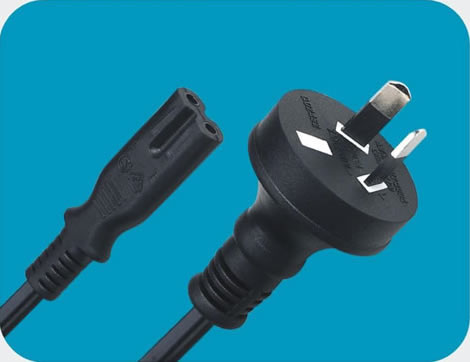
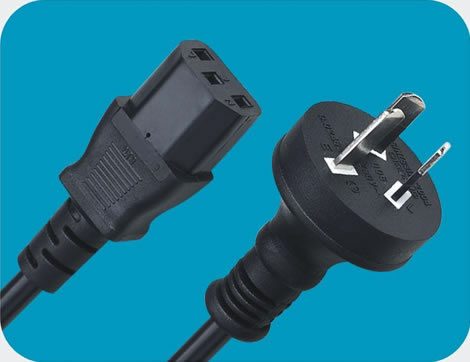
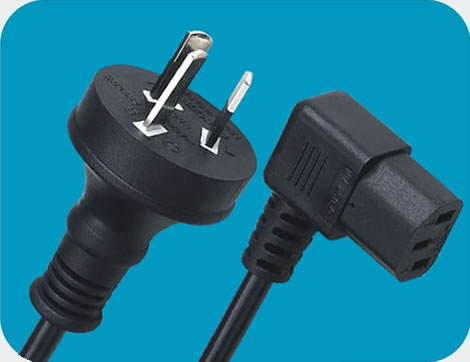
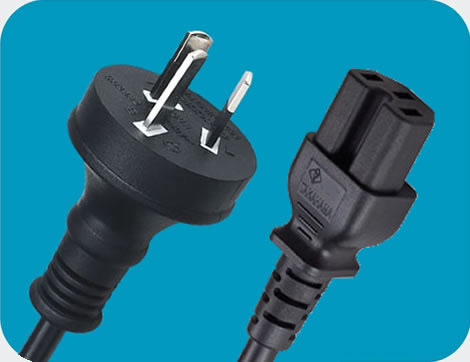
Not every Australian cord ends in a connector. Open-end cords with stripped and tinned conductors, crimp terminals or ferrules are common on equipment built into a machine. On those the cord is part of the installation, not an accessory. The same wire end options guide covers the terminal, receptacle and switch endings that apply to the Australian plug as well.
Which Countries Use Type I
The AS/NZS 3112 plug is the mains standard in Australia and New Zealand. It travels with Australian equipment into most of the Pacific. Fiji, Tonga and Papua New Guinea still run a nominal 240 V rather than 230 V. The Solomon Islands run 220 V. Same plug, slightly different voltage, depending on the island.
| Country or territory | Voltage | Notes |
|---|---|---|
| Australia | 230 V, 50 Hz | Nominal 230 V since 2000, transition completed in 2022. 10 A, 15 A and 20 A sockets in domestic and commercial use |
| New Zealand | 230 V, 50 Hz | Same plug and same standard. Cords approved for Australia are accepted in New Zealand and the reverse |
| Fiji | 240 V, 50 Hz | Type I, Australian pattern. SAA approval accepted in practice |
| Papua New Guinea | 240 V, 50 Hz | Type I, Australian pattern |
| Tonga | 240 V, 50 Hz | Type I, Australian pattern |
| Solomon Islands | 220 V, 50 Hz | Type I, Australian pattern |
| Samoa, Cook Islands, Vanuatu, Kiribati, Tuvalu, Nauru, Niue | 220 to 240 V, 50 Hz | Type I in common use, usually the Australian pattern. Local certification requirements vary and are worth checking per shipment |
| China | 220 V, 50 Hz | Type I geometry to GB 1002, but a separate standard, no insulated pins on the older design, and the socket is often mounted earth-up. Not interchangeable with AS/NZS 3112 in either direction |
| Argentina | 220 V, 50 Hz | Type I geometry to IRAM 2073, with active and neutral reversed against the Australian layout. An Australian plug enters an Argentine socket and puts live on the wrong pin |
Argentina is the case that causes real trouble, because the plug looks right and goes in. The Australian plug has active on the left and neutral on the right, viewed from the face with the earth down. Argentina has them the other way round. On a Class II appliance that is a polarity fault with no immediate symptom. On anything with a single-pole switch it leaves the appliance live with the switch off. The earth pin differs too: 19.94 mm on the Australian plug against 21.4 mm on the Argentine one, enough for a poor contact in some sockets. A cord approved for Australia is not a cord approved for Argentina, whatever the plug looks like.
Voltage, frequency and socket types for every market are listed on the world voltage and plug specifications page, including the markets outside this list that take the same plug.
Australia vs UK vs US vs Europe
The four systems differ in the things that matter to an order. What current the plug allows. Whether it carries a fuse. Whether it is polarised. How the product gets approved.
| Feature | Australia (AS/NZS 3112) | UK (BS 1363) | US (NEMA 5-15) | Europe (CEE 7/7) |
|---|---|---|---|---|
| Plug | Two flat angled pins plus a flat vertical earth | Three rectangular pins, earth at the top, sleeved | Two flat blades and a round earth pin | Two round pins with side earth clips |
| Mains | 230 V, 50 Hz | 230 V, 50 Hz | 120 V, 60 Hz | 230 V, 50 Hz |
| Maximum current | 10 A standard, 15 A and 20 A on larger plugs, about 2.3 kW to 4.6 kW | 13 A, about 3 kW | 15 A, about 1.8 kW | 16 A, about 3.7 kW |
| Fuse in plug | No. Circuit protection is at the board | Yes, a BS 1362 cartridge from 3 A to 13 A | No | No |
| Polarity | Polarised: active left, neutral right with the earth down | Polarised | Polarised | Not polarised: a Schuko plug goes in either way |
| Insulated pins | Mandatory since 2005 | Sleeved pins required | Not required | Required on the Europlug, not on Schuko |
| Certification route | SAA certificate of conformity plus RCM under the EESS | ASTA Diamond Mark, BSI Kitemark and UKCA | UL 817 and cUL listing | CE declaration plus ENEC and national marks |
| Interchangeable? | No. Each system needs its own wall socket, and a Type I plug is the only one of the four that will enter an Argentine or Chinese socket | |||
The Australian and New Zealand arrangement is unusual in having no fuse in the plug and no polarity-neutral plug body. Protection sits at the distribution board, on a circuit rated 10 A, 16 A or 20 A depending on the socket. The plug rating has to match the circuit rather than protect itself. That is why the earth pin interlock carries so much weight. It is the only thing stopping a 15 A appliance being plugged into a 10 A circuit.
Common Applications
IT and Data Centres
Server and monitor leads on 1.0 mm² ordinary duty V-90 cord, with C13, C15 or C19 ends and right-angle bodies where rack depth is tight. Above 10 A the rack moves to C19 and C20, and above 16 A to IEC 60309.
Domestic Appliances
10 A plug to C13 or C15 on 1.0 mm² for kettles, toasters and white goods, and 15 A plug on 1.5 mm² for air conditioners and ovens. The C15 notch matters on anything that heats.
Outdoor, Site and Caravan
Heavy duty 0.6/1 kV rubber cord on 15 A plugs for site leads, caravan leads and welders, with moulded bodies that survive being dragged and left in the sun. Extension leads in this range run from 5 m to 25 m.
Lighting and Class II Equipment
2-pin 10 A plug on flat 2-core light duty cord, ending in a C7 connector or a stripped end, for lamps, audio products and small power supplies where no earth is needed.
Extension leads and socket strips follow the same plug family. They are covered separately under Australia extension cords. The cable behind them is listed under VDE, TUV, SAA, KC and Inmetro PVC power cables and the matching rubber range, and the plug bodies themselves are on the Australia SAA power cord page.
Looking for SAA Approved Australian Power Cords?
ChengBang builds Australian cord sets with AS/NZS 3112 plugs in 2-pin and 3-pin, 10 A, 15 A and 20 A, straight, side-entry and angle bodies, on AS/NZS 3191 V-90 cord from 0.75 mm² to 2.5 mm², terminated with IEC 60320 C5, C7, C13, C14, C15, C19 or C20 connectors or left open for terminals. Certificates of conformity and test reports to AS/NZS 3112 and AS/NZS 3191 come with the order, and we work with your Australian importer on the RCM declaration. Send the drawing, the sample or the part number with the plug rating and approvals the market needs, and we will reply with price and lead time.