
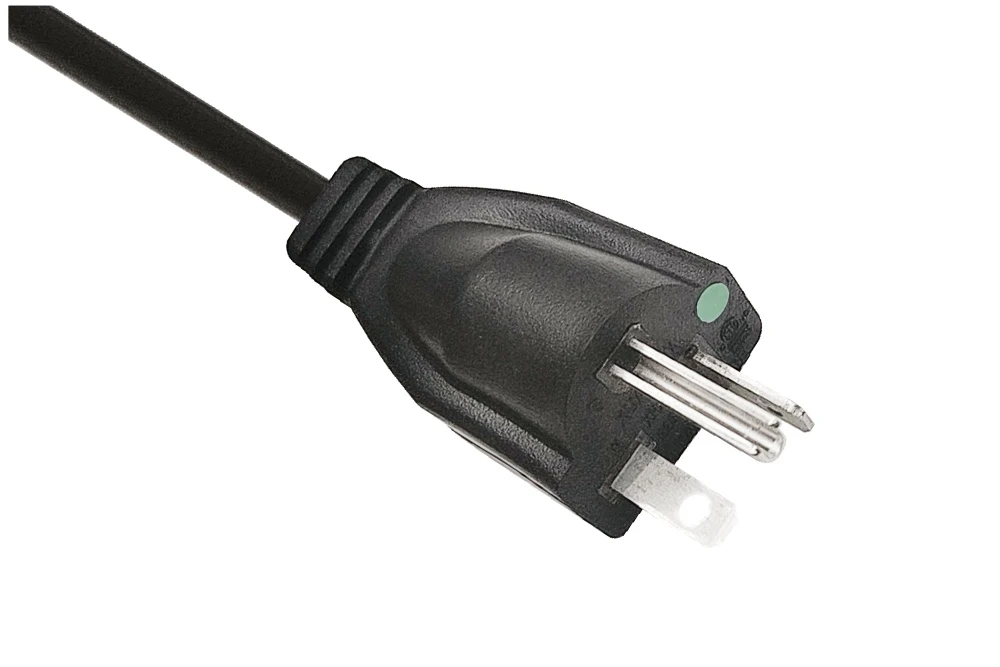
What Makes a Cord Hospital Grade?
A hospital grade plug is tested to a higher set of requirements inside UL 498 than a standard grade plug. The differences that matter on a cord are grounding reliability, blade retention and mechanical strength. The ground pin and its connection have to survive test currents that would reveal a high-resistance ground path, the blades have to grip tightly enough that the plug does not fall out of a receptacle when pulled sideways, and the assembly has to stay intact when a cart rolls away with the cord still attached.
Those requirements exist because of how the cord is used. In a patient-care area the cord runs from a wall receptacle to equipment that is moved, cleaned and unplugged many times a day. A plug that works loose can leave a monitor running on a degraded ground path, and nobody notices until the equipment behaves strangely or an alarm sounds. Hospital grade hardware is the mechanical answer to that failure mode.
Scope: hospital grade covers the plug and the receptacle as devices. A finished hospital grade cord is a normal cord set or power supply cord, assembled with a hospital grade plug and certified to UL 817 with the hospital grade plug listed under UL 498.
Green Dot and Markings
The green dot is the traditional North American identifier for hospital grade devices. On a receptacle it sits on the face next to the slots; on a cord plug the manufacturer molds it into the body, usually together with the words Hospital Grade. A hospital grade plug also carries the usual listing marks, the manufacturer's identification and the electrical rating.
Buyers who need to verify a supplier should ask for the listing document rather than looking for the dot alone. A molded dot proves nothing by itself, while the UL 498 hospital grade listing, the file number and the certificate for the finished cord set can all be checked. That is the same documentation a hospital's biomedical department will ask for when it writes the cord into a specification. The blade interface itself does not change: a hospital grade 5-15P plug mates with the same receptacle as a standard 5-15P, and the difference is in the testing it survives.
The listing behind the dot is issued by a nationally recognized testing laboratory rather than by one brand of laboratory. Intertek lists hospital grade plugs to the same UL 498 requirements under the ETL mark, and adds the cETL mark for Canada, so a cord set can arrive with either the UL mark or the ETL and cETL marks on the plug while the standard behind them stays the same. A purchase specification is better off naming UL 498 than naming one laboratory, because both listings are accepted in the United States and Canada. What settles an audit is the listing report and its file number, whether the mark molded into the body reads UL or ETL.


Configurations
Hospital grade cord plugs are made in the two 125 V grounded configurations that cover medical equipment on a standard branch circuit. Both are 2-pole 3-wire, so the cord carries line, neutral and ground.
| Configuration | Rating | Poles / wires | Equipment |
|---|---|---|---|
| 5-15P | 15 A, 125 V | 2-pole, 3-wire | Monitors, infusion pumps, examination lights, bedside equipment on a 15 A circuit |
| 5-20P | 20 A, 125 V | 2-pole, 3-wire | Imaging and laboratory equipment drawing more than 15 A, mobile carts with several devices |
The blade geometry is identical to the standard grade version of the same configuration, so a hospital grade 5-15P fits any 5-15R. The difference is in the plug's construction and testing, not in the shape of its interface. The straight-blade versions of the same configurations are listed in the American power cord guide.
Body Styles
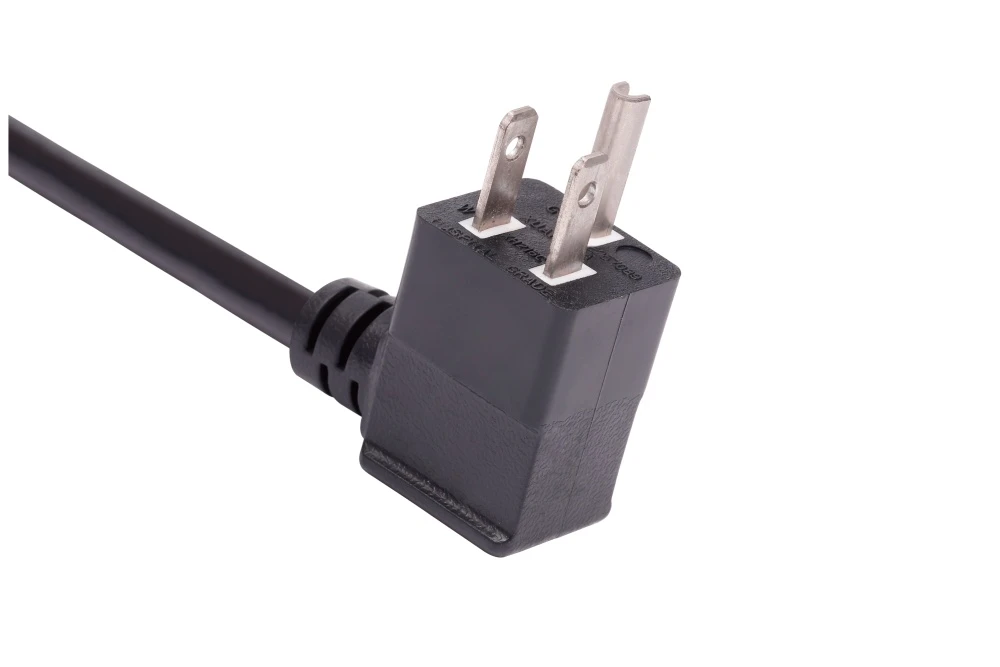
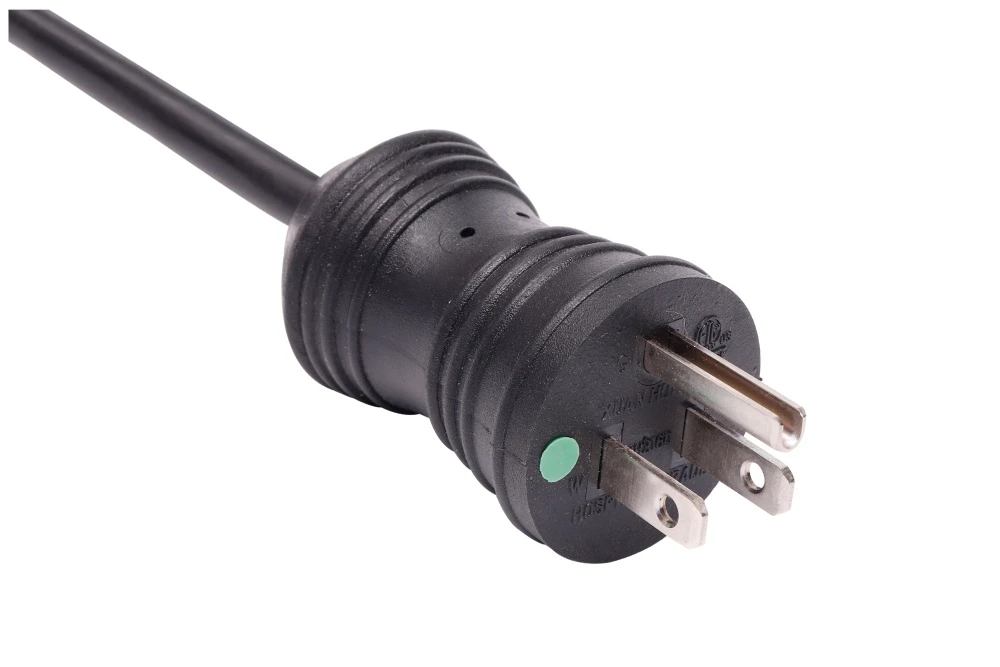
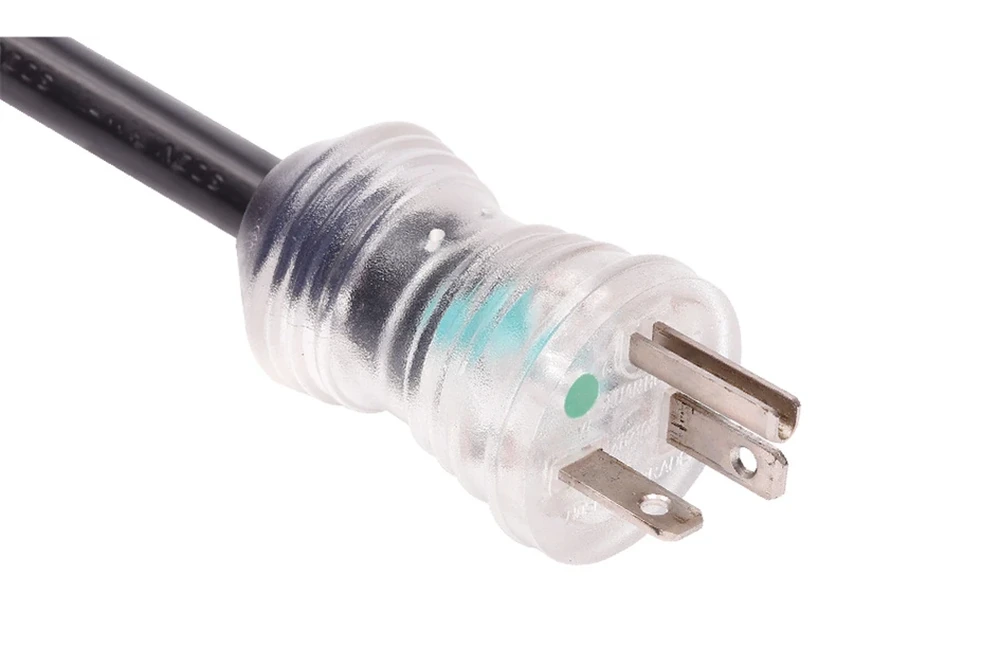
Most hospital grade cords we mold are built with a right angle body, because equipment sits against a wall or on a cart where a straight plug catches on everything. Round, square and transparent bodies are also standard.
| Body | Character | Typical use |
|---|---|---|
| Right angle | Low profile, cable exits parallel to the wall | Wall-mounted equipment, carts pushed against a headwall |
| Round | Rounded body, comfortable to grip | Equipment handled by staff many times a day |
| Square | Flat sides, sits straight in the hand and on a bench | Laboratory benches and service workshops |
| Straight | Standard in-line body | Equipment with open space behind it |
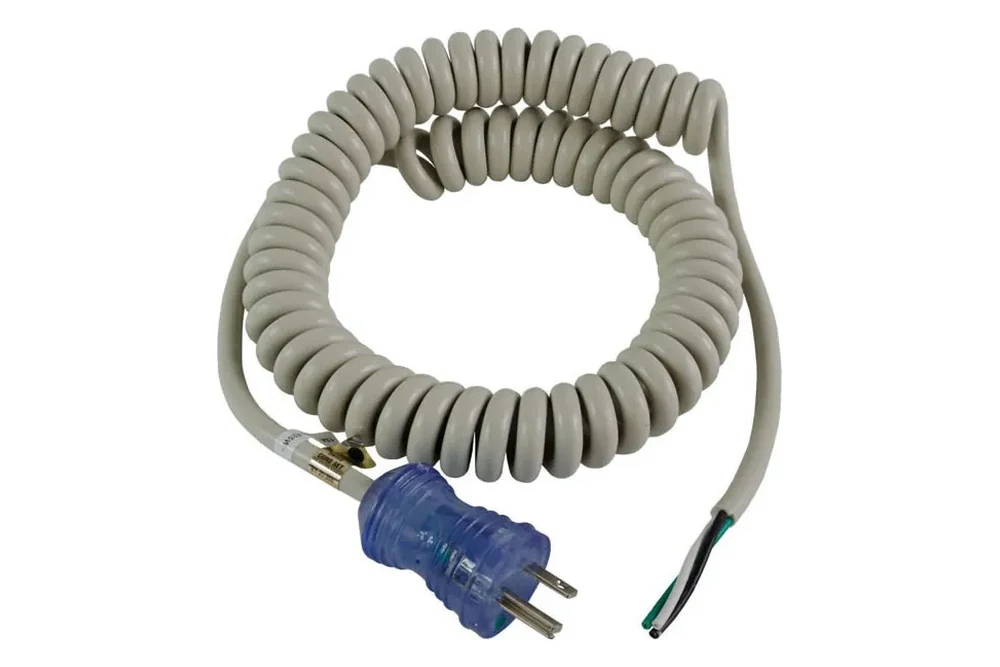
| Transparent | Clear molded body, terminations visible | Biomedical inspection and equipment where tampering should show |
Where They Are Used
Hospital grade cords appear wherever equipment is plugged in inside a patient-care area, and in a few other places where the same mechanical robustness is wanted. Equipment that is moved or unplugged while it is running is a case for the locking versions, covered in the twist-locking power cord guide.
| Setting | Typical equipment |
|---|---|
| Patient rooms and wards | Vital signs monitors, infusion and syringe pumps, beds and bed rails, examination lights |
| Operating and procedure rooms | Procedure lights, anaesthesia equipment, electrosurgical units, instrument carts |
| Imaging and diagnostics | Ultrasound, portable X-ray, ECG and monitoring carts |
| Laboratories and clinics | Analysers, centrifuges, dental and veterinary equipment |
| General commercial | Equipment where a pulled plug is expensive, such as point-of-sale and test benches |
The electrical code requires hospital grade receptacles in patient-care areas of health care facilities, and equipment cords are specified hospital grade to match. If you are supplying devices into a hospital, check the purchase specification for the wording it uses; the cord is normally part of the delivered equipment and has to comply with the same document.
Coiled and Extension Cords
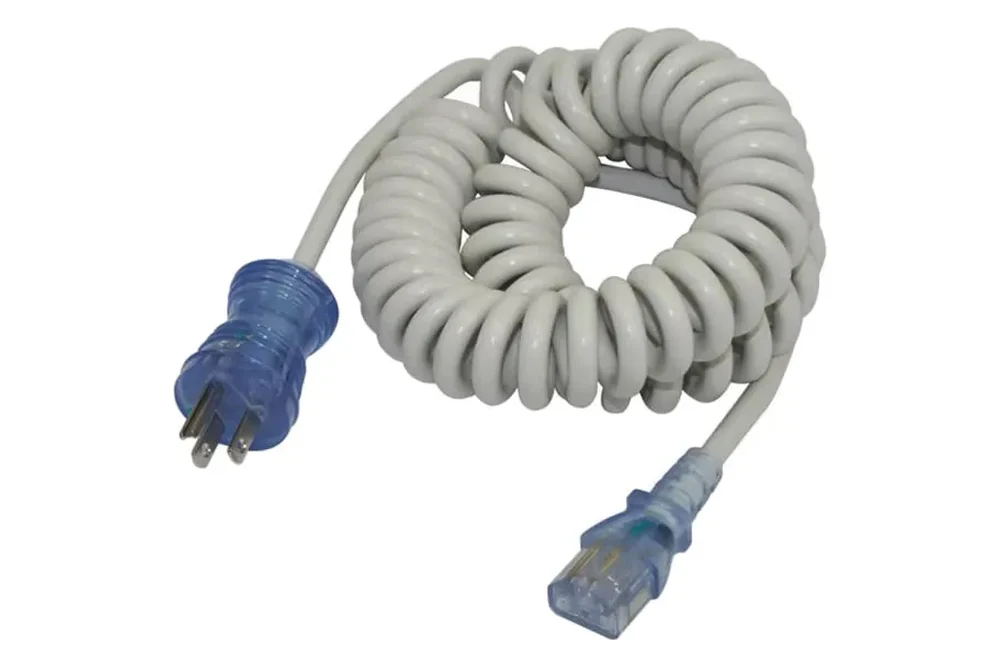
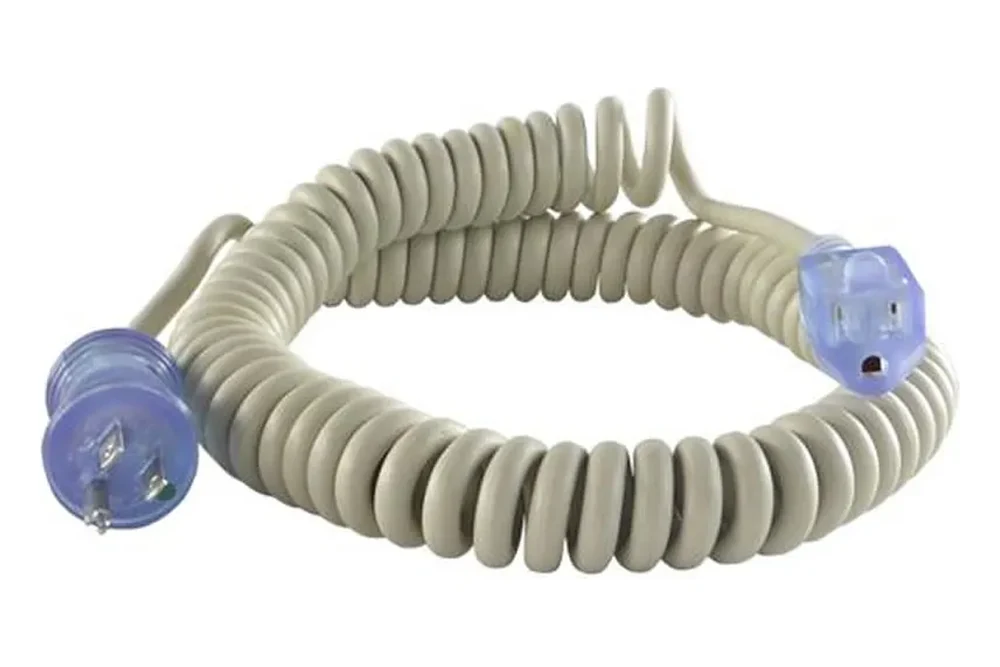
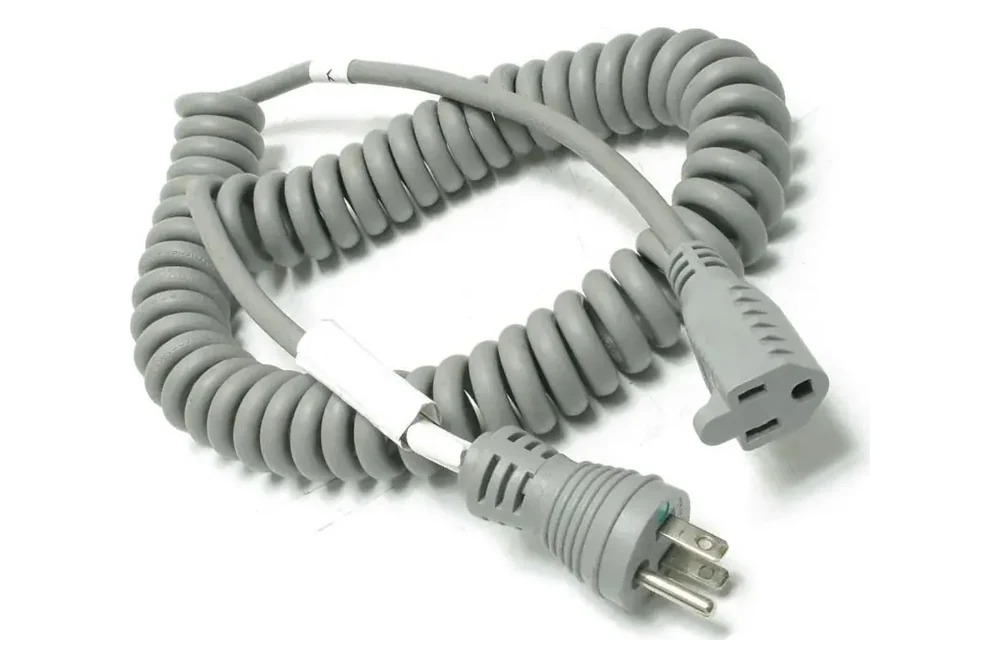
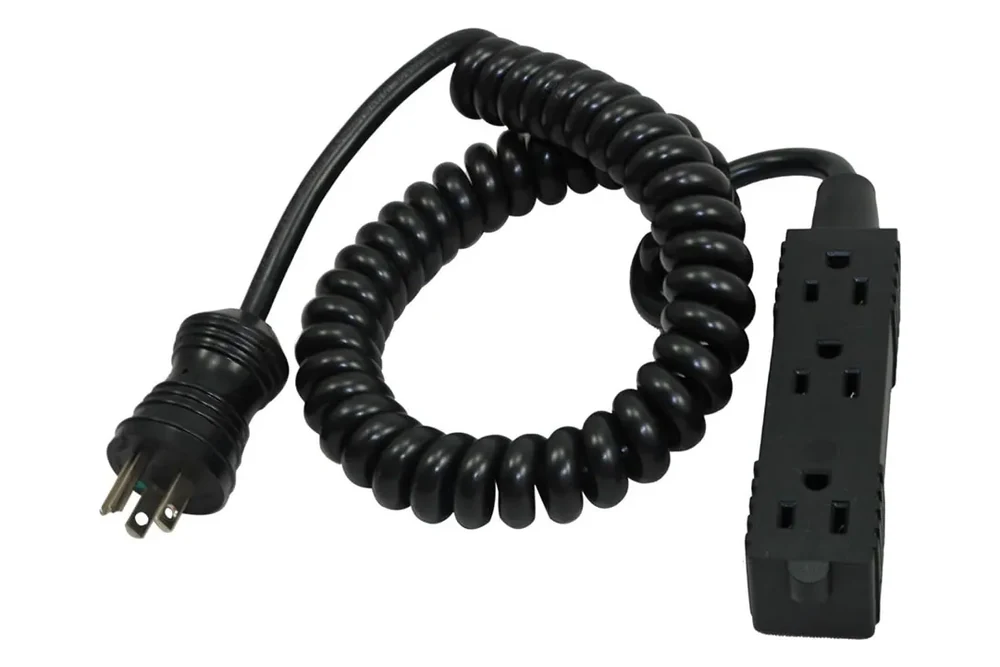
A bedside cart or a monitor arm is usually fitted with a coiled cord, so the retractable lead keeps the floor clear and stores without tangling. These are built on the same UL 817 hospital grade plug as a straight cord, and the length is measured with the coil relaxed. The same build is quoted under other names as well: retractable spring cord, coiled cord set and spiral cable all describe this construction, so a drawing using any of those terms can be quoted as it stands. Cable and coil options are on the coiled power cords page.
Hospital Grade vs Standard Grade
| Feature | Standard grade | Hospital grade |
|---|---|---|
| Standard | UL 498, standard grade requirements | UL 498, hospital grade requirements |
| Grounding path | Continuity tested | Tested against a tighter resistance limit on the grounding conductor and pin |
| Blade retention | Standard withdrawal force | Higher withdrawal force, so the plug does not fall out of a worn receptacle |
| Mechanical strength | Normal handling | Tested for the abuse a cart-mounted cord receives |
| Marking | Listing mark and rating | Listing mark, rating and the manufacturer's hospital grade identification |
| Cost | Lower | Higher, from the extra testing and heavier construction |
| Interchangeability | Same blade geometry, so either fits the same receptacle. The specification, not the outlet, decides which one belongs on the equipment. | |
Cable and Materials
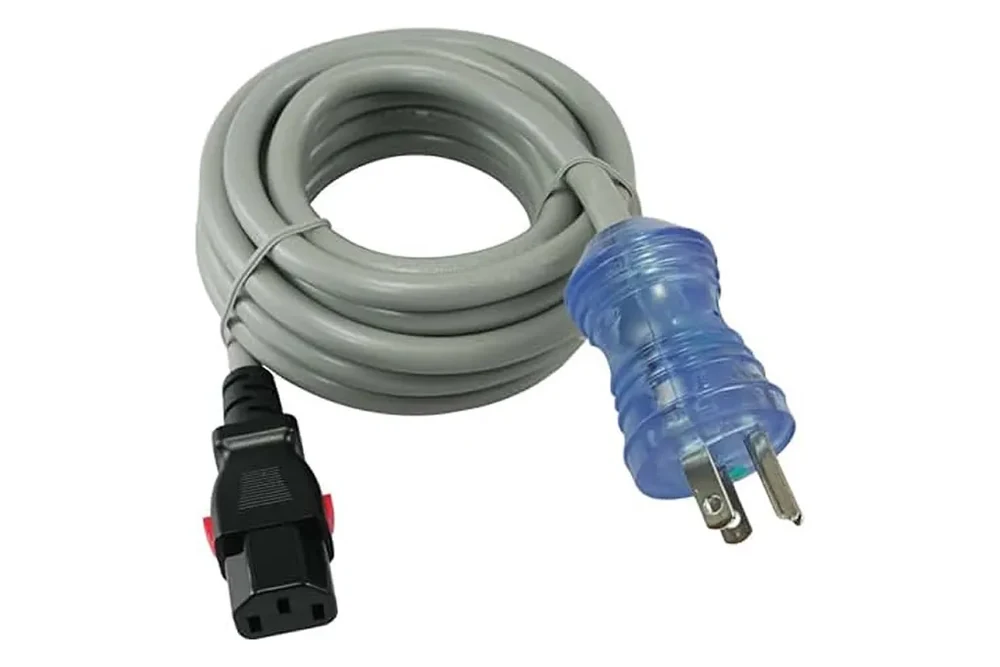
Hospital grade cords are usually built on 18 AWG or 16 AWG SJT or SVT cable in gray, black or transparent finish. The cable is rated for the current the equipment draws, and 10 A to 13 A cords are the common size for monitors, pumps and carts. Everything we mold uses RoHS, REACH and PAHs compliant compounds.
Cleaning is worth a question at the quotation stage. Hospital equipment is wiped down repeatedly with surface disinfectants, and some agents attack PVC over time. Tell us which cleaning agents your customer uses and we will confirm the jacket compound against them. Hospital grade cords are not sterile devices: they are not designed for autoclaving or immersion, and the cleaning procedure has to stay within what the equipment manufacturer allows. A cord that also has to survive washdown is a different build, covered in the IP44 waterproof power cord guide.
Connector Ends
The green dot covers the assembly, so both ends are built to the same UL 817 and CSA requirement.
| Connector end | Standard | Typical use |
|---|---|---|
| 5-15R / 5-20R | NEMA WD 6 | Monitors, pumps and carts in patient care areas |
| 6-15R / 6-20R | NEMA WD 6 | 250 V imaging and laboratory equipment |
| L5-15R / L6-20R | NEMA WD 6 | Carts and equipment that must not be unplugged |
| C13 / C15 | IEC 60320 | Made to order for monitors, pumps and imaging consoles |
| C19 | IEC 60320 | Medical IT racks and PDUs |
| Locking C13 / C19 | IEC 60320 | Equipment exposed to vibration or cable pull |
| Open end | n/a | Hard wired terminals and junction boxes |
Hospital grade is a rating of the plug, the connector and the cord set. IEC 60320 ends are not covered by the green dot mark, so a cord that feeds a monitor or a pump through a C13 end is ordered as a hospital grade cord with a made-to-order end.
Ordering Notes
Tell us the configuration, the body style and the equipment it serves, and we will quote the cord with hospital grade plugs, the cable and the length you need. Hospital grade plugs in 5-15P and 5-20P are molded off existing tooling, in right angle, round, square, straight and transparent bodies.
Looking for Hospital Grade Power Cords?
We mold NEMA 5-15P and 5-20P hospital grade cords in right angle, round, square, straight and transparent bodies, with SJT or SVT cable in gray, black or clear, and UL 817 and cUL certification for the finished cord. Custom lengths, colors and private labeling are standard.
Typical MOQ is 200 to 1,000 pieces, samples ship in 7 to 15 days and production runs 15 to 20 workdays.